
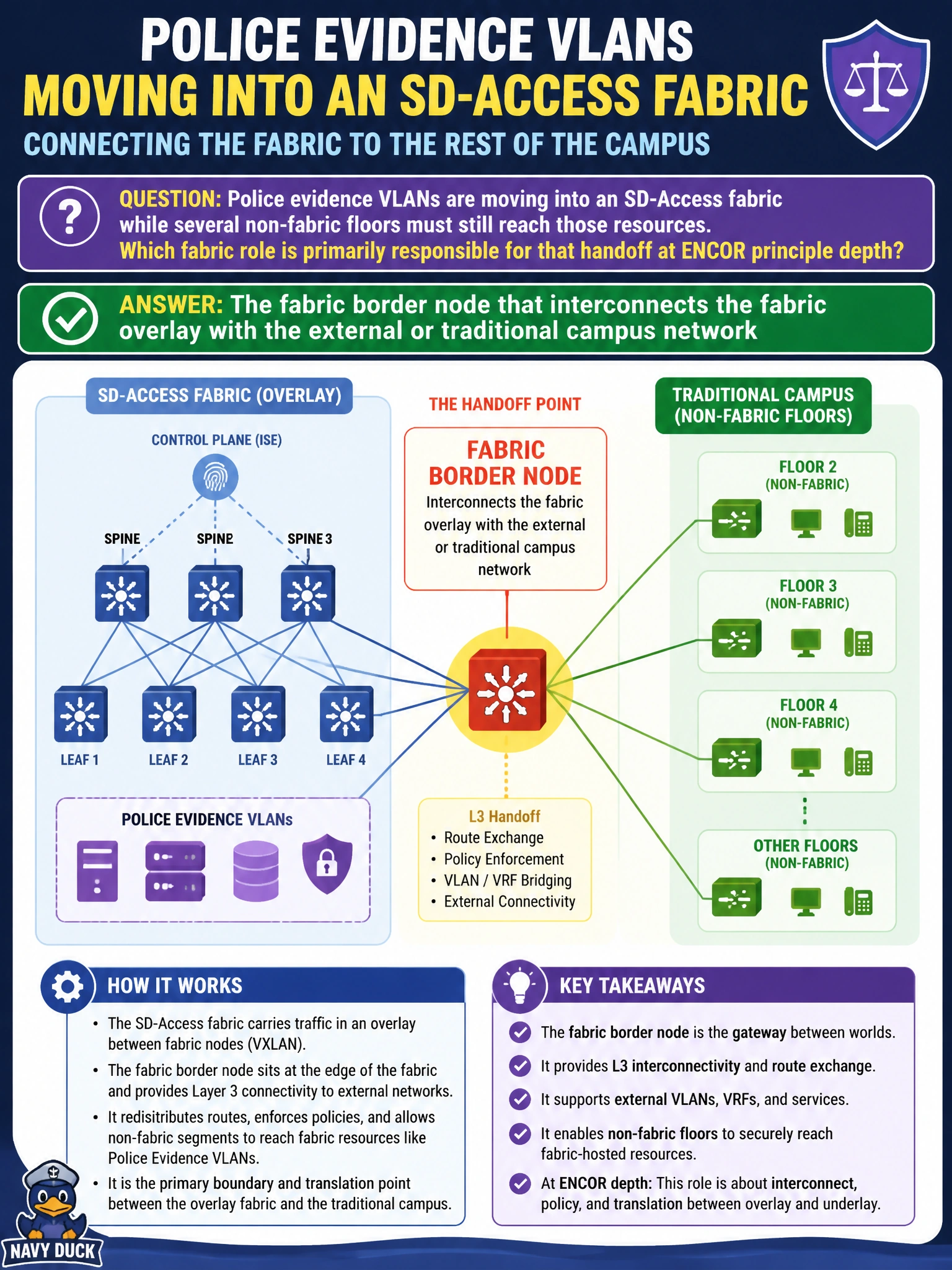
Police evidence VLANs are moving into an SD-Access fabric while several non-fabric floors must still reach those resources. Which fabric role is primarily responsible for that handoff at ENCOR principle depth?
Select an answer to reveal the explanation.
Short Explanation
Picture the fabric as a gated campus and the old floors as the public street. The border is the gatehouse that knows how to talk to both sides. Without that gatehouse, evidence VLANs inside the fabric have no clean way to meet the non-fabric floors.
Full Explanation
In Cisco SD-Access, fabric roles are separated so each node type owns a clear job during migration and steady state. When police evidence resources move into the fabric while non-fabric floors must still reach them, the role that primarily provides that handoff is the fabric border. Border nodes interconnect the fabric overlay with external networks and traditional campus blocks, translating between fabric-aware forwarding and classic Layer 2/Layer 3 domains so civic services remain reachable across both sides of the rollout.
Assigning the handoff job to the wireless LAN controller alone is incorrect. A WLC is central to wireless architecture and CAPWAP termination, but it does not replace the campus fabric border for interconnecting fabric overlay traffic with traditional wired floors that still need evidence VLAN reachability. A Layer 2 access switch with BPDU Guard on user ports is performing STP edge protection; that feature prevents rogue switches from injecting BPDUs on access ports and is unrelated to overlay-to-traditional fabric handoff. Treating the control-plane node as if it encrypts all northbound traffic and exclusively owns external connectivity also misstates the role: the control plane maintains endpoint identity and location mappings for the fabric, while the border is the interoperability point toward non-fabric networks.
Exam caveat: ENCOR items often mix fabric roles. Do not equate 'anything fabric-related' with the border, and do not confuse control-plane mapping services with Layer 3/overlay handoff to traditional campus blocks.
Operational check: identify which devices are designated borders, verify routing and policy between fabric virtual networks and the traditional evidence path, and confirm that non-fabric floors can reach fabric-hosted evidence resources only through the intended border handoff rather than through accidental Layer 2 bridging.