
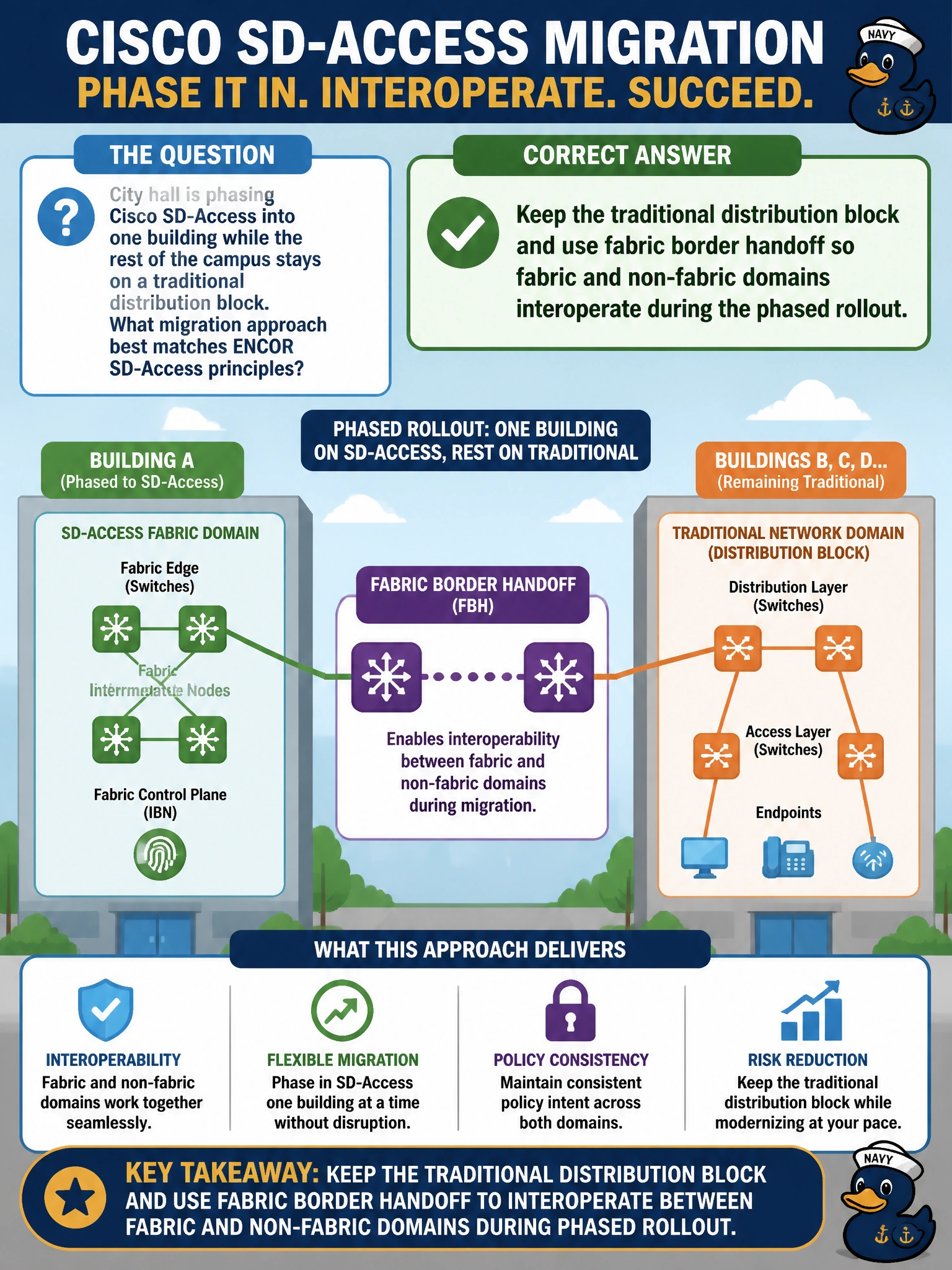
City hall is phasing Cisco SD-Access into one building while the rest of the campus stays on a traditional distribution block. What migration approach best matches ENCOR SD-Access principles?
Select an answer to reveal the explanation.
Short Explanation
Think of it like renovating one wing of city hall while the other wings stay open. You do not tear down every hallway overnight—you put a doorway (the border) between the new fabric wing and the old distribution block. That handoff is how traffic still flows during the phased move.
Full Explanation
Cisco SD-Access is designed for phased campus adoption rather than a single cutover that abandons every traditional distribution construct overnight. In a civic building such as city hall, the practical migration pattern is to leave the existing distribution block in service for floors that are not yet ready and to introduce fabric only where the rollout plan allows. The interoperability mechanism ENCOR emphasizes is the fabric border handoff: border nodes connect the fabric overlay to external or traditional Layer 2/Layer 3 campus domains so traffic can still flow between renovated and legacy areas while policy and identity are introduced building by building.
An overnight replacement of every access VLAN with VXLAN before any border exists breaks that coexistence model. Without a planned handoff, endpoints on non-fabric floors lose a controlled path into the fabric and operators are forced into an all-or-nothing change that municipal change windows rarely support. Collapsing Spanning Tree so fabric and non-fabric supposedly share one broadcast domain is likewise incorrect: STP edge protection and broadcast-domain design remain relevant on traditional segments, and mixing domains by disabling STP does not create a supported SD-Access migration path. Converting only wireless access points to fabric edge while leaving wired endpoints on process switching confuses roles and forwarding modes; fabric edge onboarding applies to wired and wireless endpoints according to design, and process switching is not a migration strategy for wired clients.
Exam caveat: questions often tempt candidates with dramatic cutovers or by mixing unrelated technologies. The scoring idea is coexistence through border/interworking during phased rollout, not a claim that traditional distribution must disappear on day one.
Operational check: confirm border node adjacency and handoff toward the traditional distribution block, verify that fabric-hosted and non-fabric endpoints can reach required services across the handoff, and stage building onboarding only after that interworking path is proven in the municipal change window.