
Emergency management asks which plane in Cisco SD-WAN is primarily responsible for building control relationships among controllers and WAN edges at principle depth?
Select an answer to reveal the explanation.
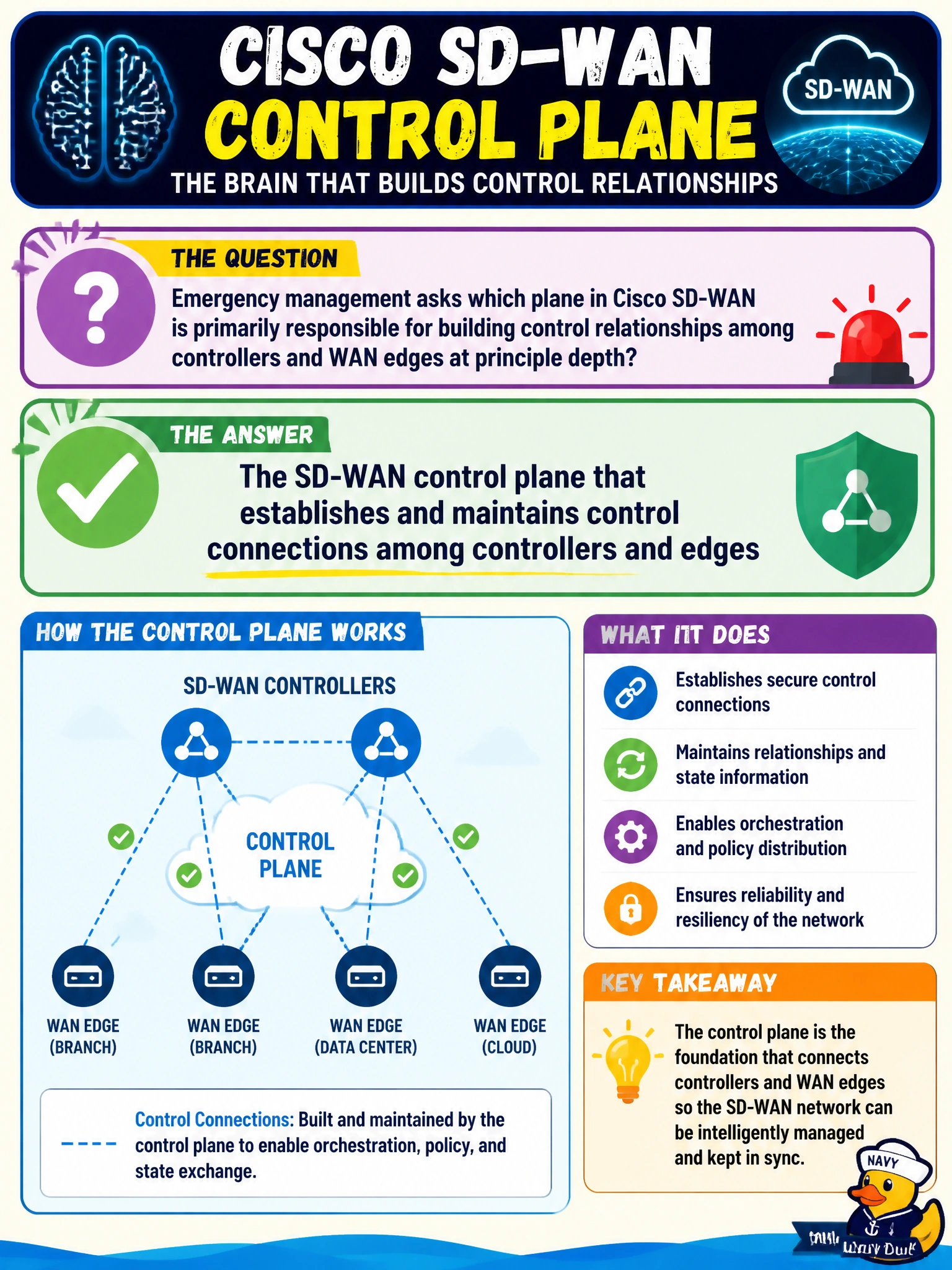
Short Explanation
Control plane is the introductions and handshakes—controllers and edges learning how to talk about the fabric. Data plane is the actual armored trucks moving packets. EM needs the handshake plane here.
Full Explanation
Emergency management asking which plane in Cisco SD-WAN builds control relationships among controllers and WAN edges is pointing at the SD-WAN control plane. That plane establishes and maintains control connections and fabric relationships so edges learn how to participate in the overlay. It is distinct from the data plane that forwards user traffic and from management/orchestration that templates and monitors the solution.
The optical DWDM data plane that only switches lambdas between clinics is not the SD-WAN control plane. The wireless RF plane that assigns DFS channels to LTE modems confuses WLAN RF with SD-WAN architecture. The Power-over-Ethernet plane that negotiates class on WAN edge switchports is Layer 1/2 power delivery, not SD-WAN control relationships.
Exam caveat: Memorize plane separation—control for relationships and routing intelligence exchange, data for forwarding, management for orchestration—without mixing in RF or PoE distractors.
Operational check: verify control connections from clinic/WAN edges to controllers are up, confirm TLOCs and site IDs form as expected, and separate troubleshooting of control flaps from data-plane encryption or throughput issues during emergency-management drills.