
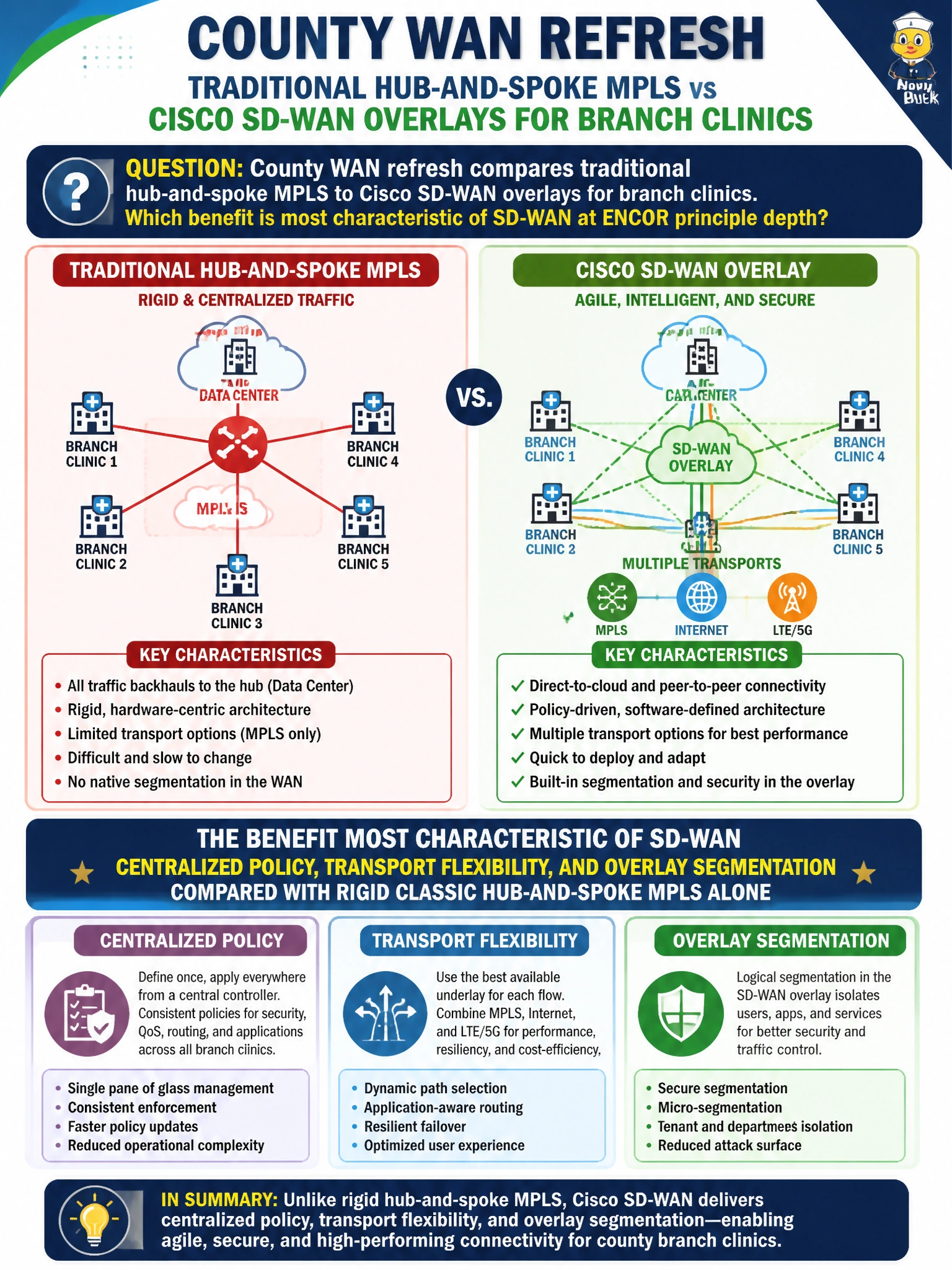
County WAN refresh compares traditional hub-and-spoke MPLS to Cisco SD-WAN overlays for branch clinics. Which benefit is most characteristic of SD-WAN at ENCOR principle depth?
Select an answer to reveal the explanation.
Short Explanation
Old hub-and-spoke MPLS is one toll road with fixed rules. SD-WAN is more like a smart traffic app—central policy, pick broadband or LTE underlays, and carve overlays—without pretending the pavement disappears.
Full Explanation
A county WAN refresh comparing traditional hub-and-spoke MPLS to Cisco SD-WAN for branch clinics should recognize centralized policy, transport flexibility, and overlay segmentation as characteristic SD-WAN benefits at ENCOR principle depth. SD-WAN overlays can ride diverse underlays (MPLS, broadband, LTE), apply centralized business policy, and segment traffic more flexibly than a rigid classic hub-and-spoke MPLS-only mindset. Clinics gain path options and consistent policy without pretending the underlay disappears.
Eliminating the need for any underlay connectivity at branch sites is false—overlays require underlay reachability. Guaranteeing zero operational complexity and zero controller dependency forever oversells the technology. Replacing all clinic LAN switching with DIY GRE only on PCs is not an SD-WAN architecture and abandons proper edge design.
Exam caveat: SD-WAN benefits are policy, transport flexibility, and overlay segmentation—not magic removal of underlays or operations.
Operational check: inventory clinic transports, define centralized application policies, pilot overlay segmentation for clinical versus guest traffic, and compare operational overhead to the legacy MPLS hub-and-spoke baseline.