
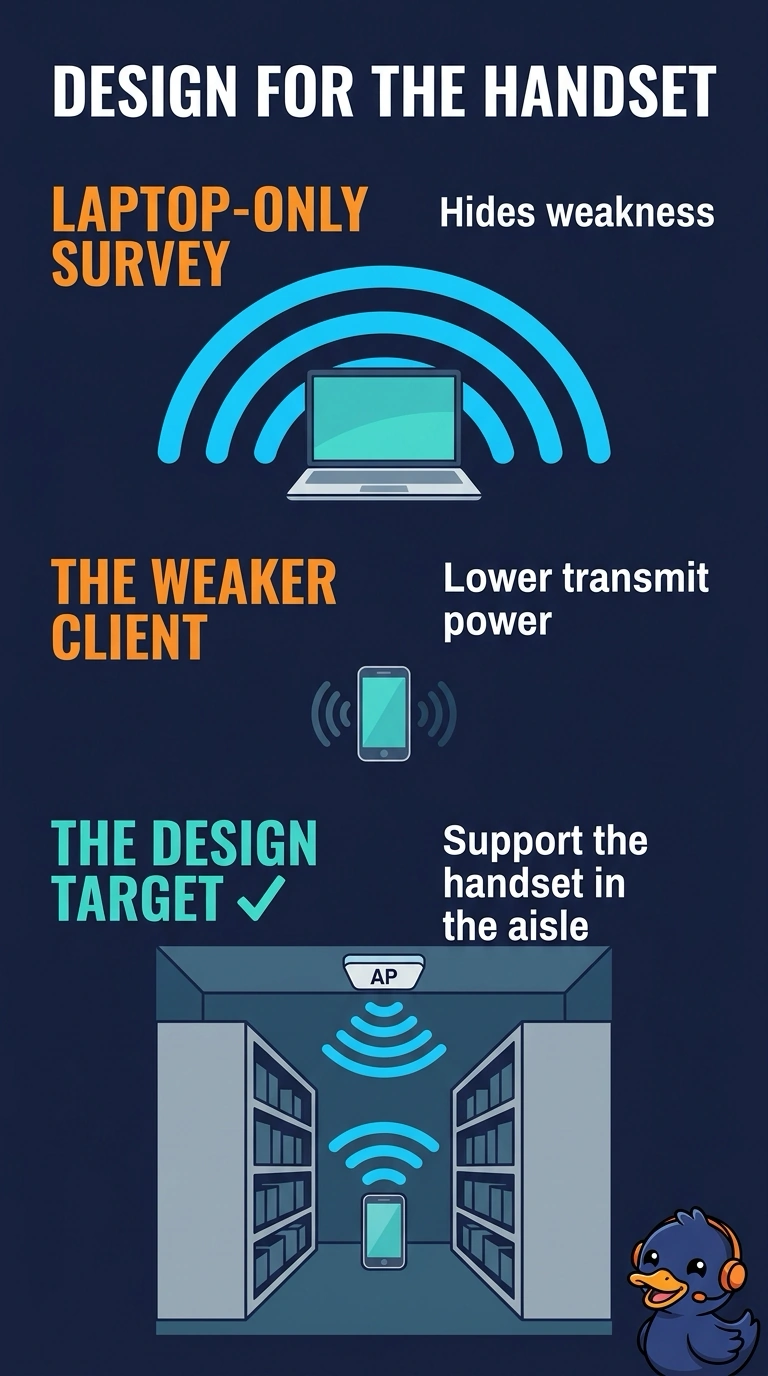
Laptops work through a warehouse aisle. A one-stream handset with lower transmit power drops in the same aisle. The design was surveyed with a laptop only. What should the cell be designed for?
Select an answer to reveal the explanation.
Short Explanation
The laptop can hear from farther away than the handset can talk. Design the aisle for the handset, which is the device that is actually failing you. A louder access point does not give the handset a louder voice.
Full Explanation
The cell has to close for the weakest client that must work there. This handset has one stream and lower transmit power, so it drops where laptops still work, and a laptop-only survey never saw that edge. Designing for the laptop hides the failure. The access point's transmit power is not the handset's transmit power. The uplink is the handset's own radio. A one-stream device does not raise the noise floor by existing. The warehouse handset is the weak client. Designing only for laptops leaves the handset outside the cell. Check one live client after the change and leave the rest of the floor alone until that client matches the result you expected. Confirm the symptom on the next attempt before changing anything else. Exam caveat: adding power on the access point can make the downlink look fine on the laptop and still leave the handset unable to answer. Measure the uplink from the handset. Operational check: walk the aisle with the handset, mark where its signal at the access point falls off, and place or power the radio for that mark.