
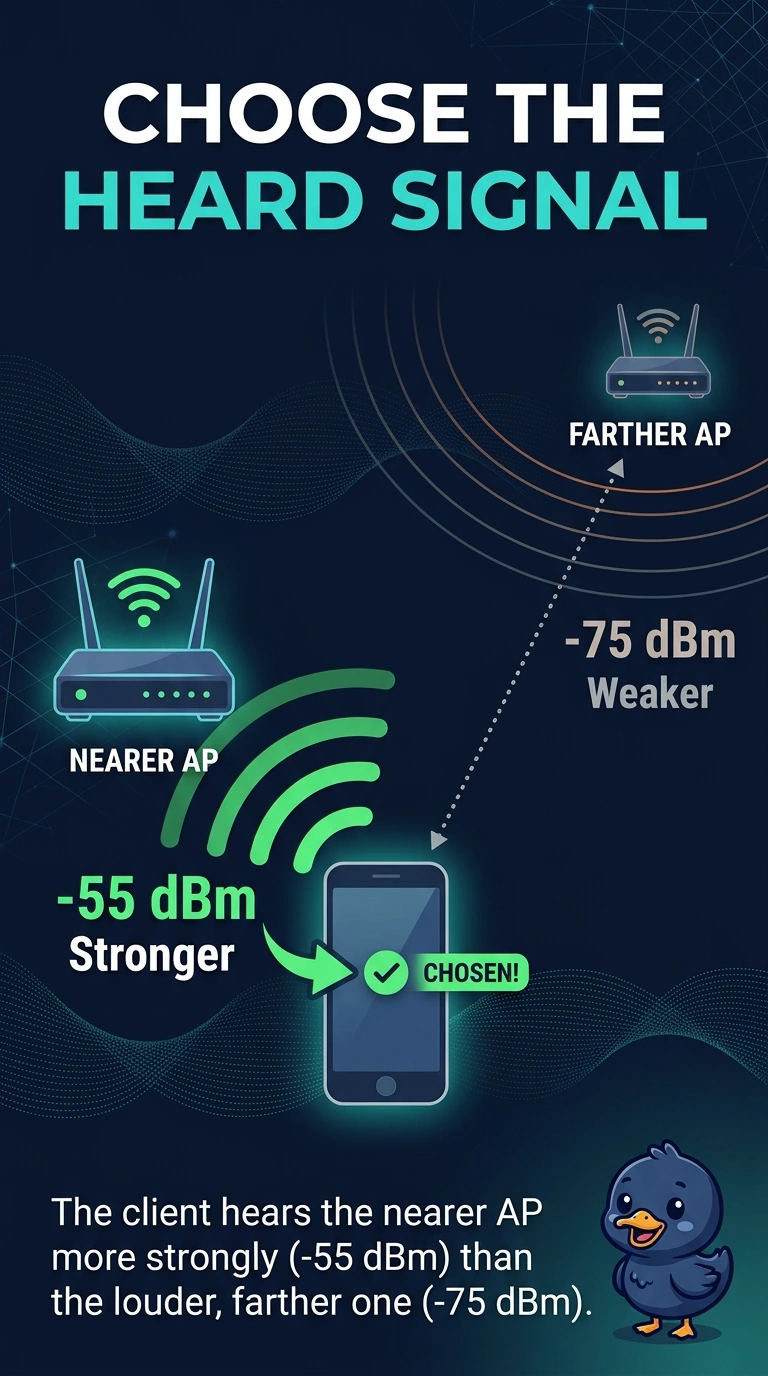
A client hears one access point at -55 dBm and another at -75 dBm. The weaker reading comes from the access point with the higher configured transmit power, which is much farther away. Which reading should drive the design?
Select an answer to reveal the explanation.
Short Explanation
The client does not sit inside the configuration. It hears what arrives, and your nearer access point arrives much stronger even with less configured power. Design from the -55 dBm reading, because a bigger number in the power box is not a bigger number at the chair.
Full Explanation
Received signal is what the client measures, and it falls with distance. This client hears -55 dBm from the nearer access point and -75 dBm from the farther one, even though the farther access point is configured for higher transmit power. The design should follow the -55 dBm reading, the signal the client actually has. Configured power is not the signal at the chair. A higher setting on a distant radio can still arrive weaker. A more negative dBm value is weaker, so -75 dBm is not the stronger reading. Received signal and configured transmit power are different quantities. They match only by coincidence. The access point with the higher configured power is farther away, and the client hears the nearer, lower-power access point more strongly. Choose the reading, not the configured number. Exam caveat: the client's own transmit power still limits the uplink. A strong downlink reading does not prove the access point can hear the client. Operational check: stand at the chair, read both access points, and use the stronger received signal when you decide which cell is serving that spot.