
A hospital break room has constant client retries on 2.4 GHz. A spectrum capture of that channel shows continuous energy that is not an 802.11 signal, and no extra beacon is present. What is the source?
Select an answer to reveal the explanation.
Short Explanation
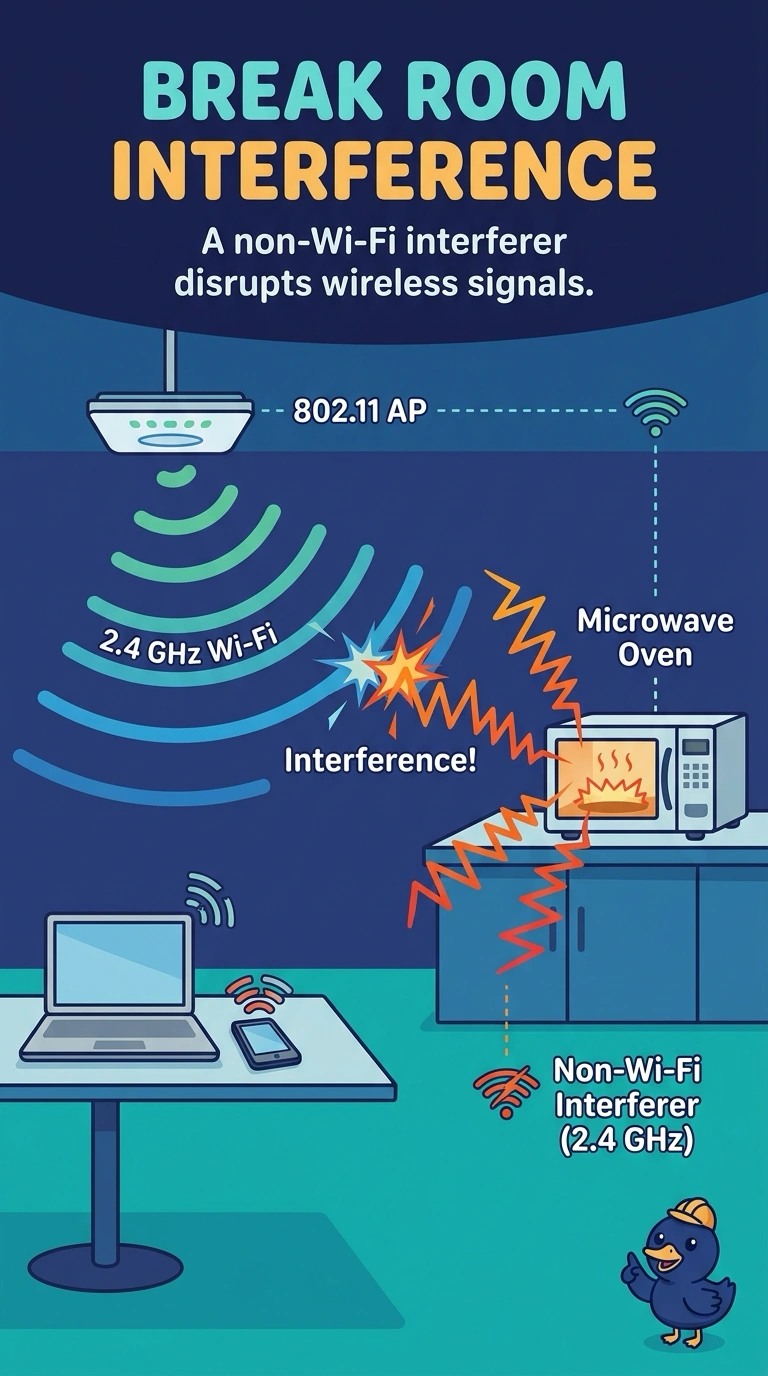
A rogue access point still speaks Wi-Fi, so you would see beacons. This capture is a continuous hum that is not 802.11 at all, which is your microwave, not a second network. DHCP trouble does not paint a band on a spectrum display.
Full Explanation
A non-Wi-Fi interferer raises the noise floor or duty cycle without sending 802.11 frames. A microwave oven in a break room is a classic 2.4 GHz example: the spectrum shows broad, continuous energy, clients retry, and there is no additional beacon. That matches the capture. A rogue access point is an unauthorized 802.11 transmitter. It advertises itself with beacons and probe responses. A capture with no extra beacon and with energy that is not 802.11 is the opposite of a rogue. DHCP failure leaves a client without an address. It does not generate non-802.11 RF energy, and a spectrum capture is not a DHCP trace. A country-code mismatch can keep radios from using illegal channels. It does not create a room-sized noise source on an otherwise working channel, and the rest of the hospital is not described as failing the same way. Exam caveat: classify the interferer before you change the channel plan. Moving to 5 GHz may dodge a microwave, and it will not help if the real source was an overlapping Wi-Fi beacon you have not found yet. Operational check: turn the break-room microwave on and off while watching the spectrum duty cycle, and confirm the non-802.11 energy tracks the oven.