
A logistics engineer compares two access-point power settings, 17 dBm and 20 dBm, on the same radio and antenna. Which statement about the 20 dBm setting is correct?
Select an answer to reveal the explanation.
Short Explanation
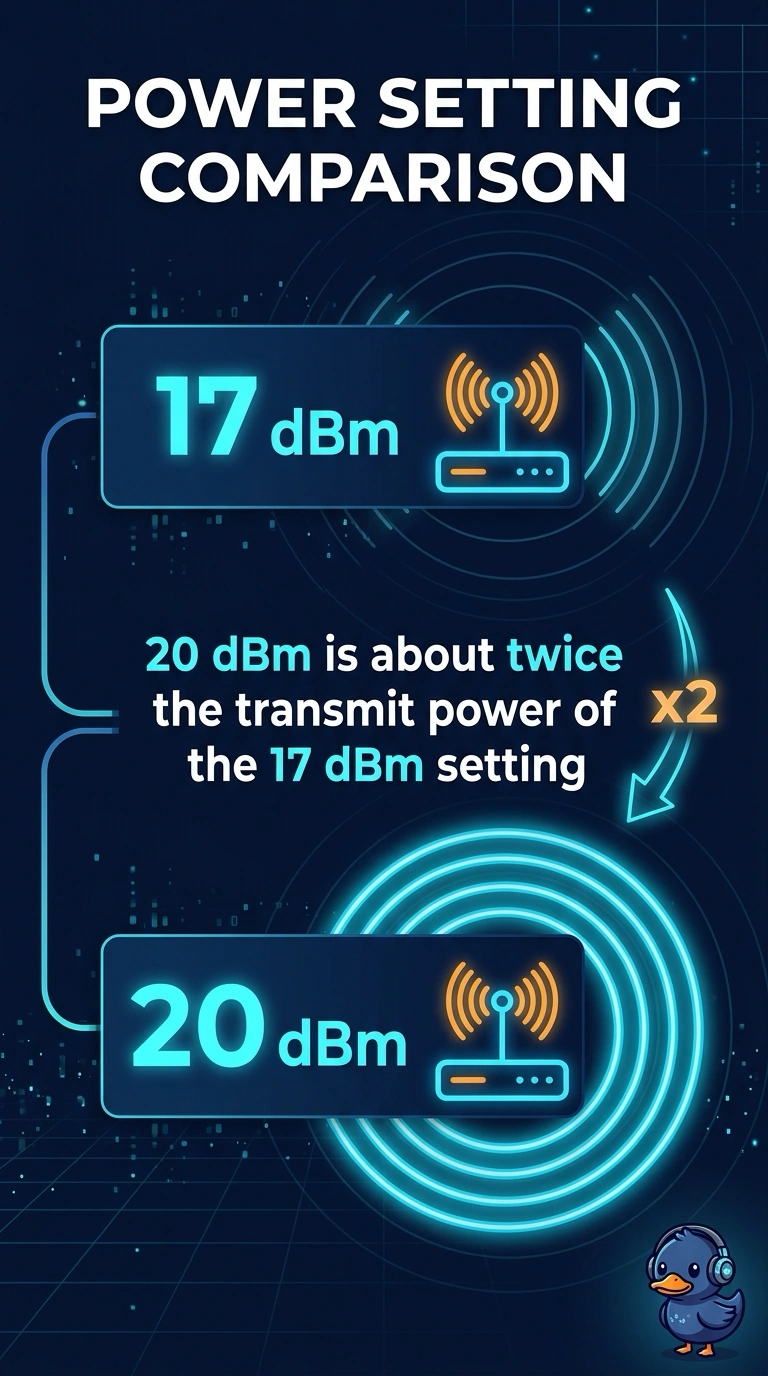
Decibels are a ratio, not a tip jar you add one milliwatt at a time. Three more dB is about twice the power, so your 20 dBm setting is about double the 17 dBm setting. The number 20 is not a 20-fold increase over 17.
Full Explanation
A difference of 3 dB is a factor of about two in power, because 10 log10 of 2 is just over 3. The 20 dBm setting is 3 dB above 17 dBm, so it is about twice the transmit power, 100 milliwatts compared with about 50 milliwatts. The radio and antenna are the same, so the comparison is the power setting itself. Reading 20 and 17 as a 20-fold ratio treats the dBm numbers as a linear multiplier. They are logarithmic. Nothing in a 3 dB step produces a twenty-times change. A 10 dB step is the ten-times rule, and this step is not 10 dB. Each dBm step is not 1 milliwatt. dBm is already a logarithmic measure relative to 1 milliwatt, so you cannot add the 3 dB difference as 3 milliwatts. A larger dBm value is more power, not less. Half the power would be about 3 dB down, near 14 dBm, not 20. Exam caveat: the power setting is not automatically the EIRP. Antenna gain adds and cable loss subtracts before you compare the result with a regulatory limit. Operational check: convert both settings to milliwatts, or subtract them in dB, and confirm the difference is about 3 dB before you change a floor-wide template.