
A hospital mounts a corridor access point, then installs a lead-lined imaging door between that access point and the waiting room. Waiting-room clients fall to a much weaker signal, while a laptop that stays beside the access point does not change. Which propagation effect accounts for the waiting-room drop?
Select an answer to reveal the explanation.
Short Explanation
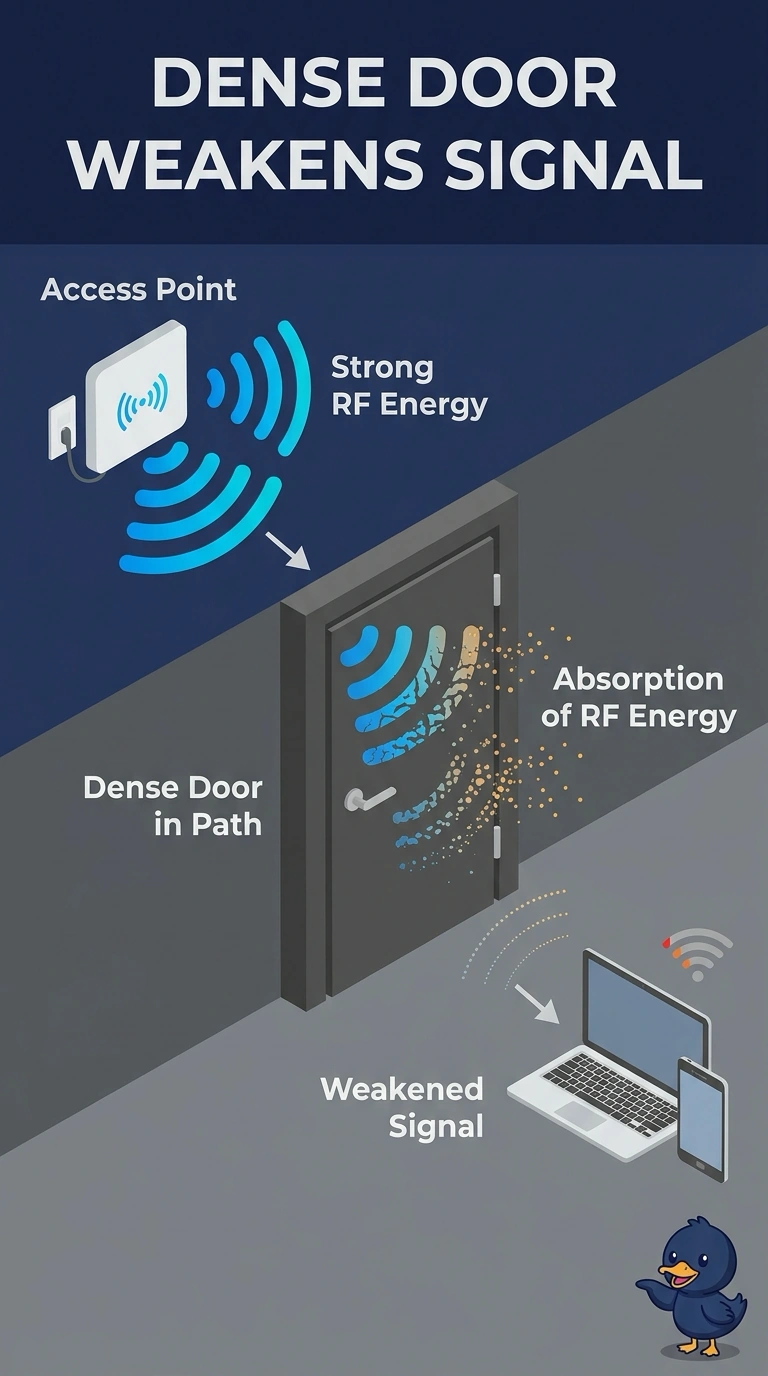
A lead-lined door absorbs RF energy, much like a soaked blanket weakens a flashlight beam. Your laptop beside the access point never crosses the door, so its reading stays put. You can rule out a longer walk down the corridor because the corridor did not get longer; the new obstruction is the clue.
Full Explanation
Absorption converts RF energy to heat inside a dense material, so less power emerges on the far side even though the access point and clients did not move. A lead-lined imaging door attenuates Wi-Fi in this way: the path changed, but the distance did not. The laptop beside the access point is a useful control because it does not cross the door and its signal is unchanged, pointing to the new door as the source of the waiting-room drop. Free-space loss increases as the path gets longer—about 6 dB each time free-space distance doubles—but the corridor did not get longer. Co-channel overlap would require the added second access point to use the same channel and would cause contention and retries, rather than a drop isolated beyond the newly installed door. A client antenna polarization flip can reduce signal when antenna orientations differ, but no client antenna changed orientation, and the door does not flip polarization only in the waiting room. Exam caveat: metal can also reflect RF energy, so a thin metal skin may bounce energy as well as absorb it; the key clue remains the new object in the path. Practical check: measure the same client on both sides of the closed door, then compare the readings with the door held open.