
A branch FlexConnect WLAN centrally switches every client across a congested WAN. Clients associate quickly and then crawl. The branch has the VLAN and the gateway locally. What change keeps client data off that WAN?
Select an answer to reveal the explanation.
Short Explanation
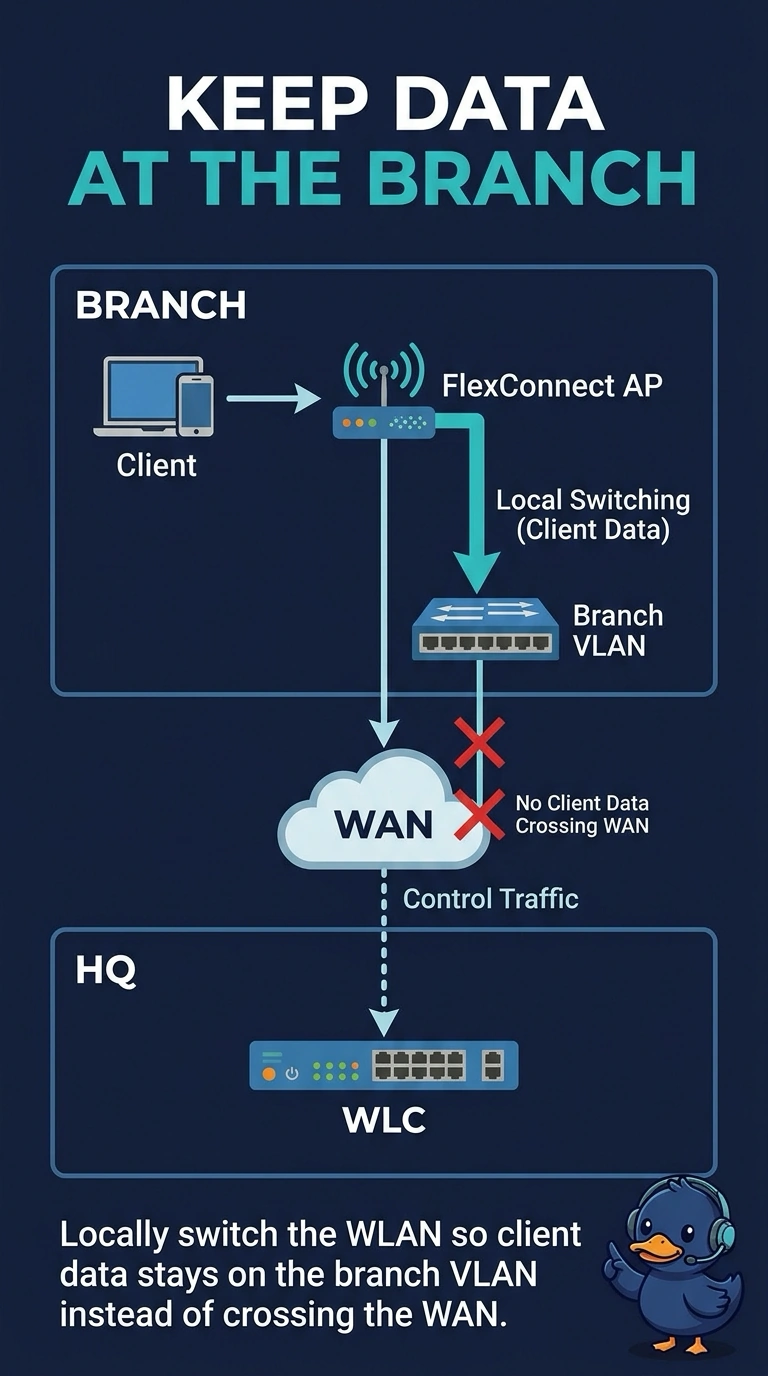
The clients are being hauled back across a crowded WAN for no reason. Your branch already has the VLAN and the gateway. Switch them locally and leave the WAN for control traffic, because sniffer mode will not carry them at all.
Full Explanation
Central switching tunnels client data to the controller, so a congested WAN sits in the middle of every flow even when the branch has the VLAN and the gateway. Local switching bridges those clients onto the branch VLAN and takes the data off the WAN. Sniffer mode captures one channel and does not serve clients, so it does not skip the WAN. It stops client service. Hiding the SSID does not move a centrally switched VLAN onto a branch gateway. The switching mode does that. The beacon interval does not change where client data is bridged, and a shorter beacon will not pull centrally switched traffic out of the WAN. The branch gateway is already local. Keeping the data tunnel across the congested WAN is what makes associated clients crawl. Exam caveat: local switching needs the client VLAN on the branch trunk and a local gateway. The stem says both exist. If either were missing, local switching would associate clients and then fail addressing. Operational check: switch one WLAN to local switching, confirm a client address comes from the branch scope, and confirm a file transfer no longer crosses the WAN.