
A warehouse hides the SSID and configures no passphrase and no 802.1X. A capture still shows client probes that name the network, and frames are readable. Why is hiding the SSID not the control they need?
Select an answer to reveal the explanation.
Short Explanation
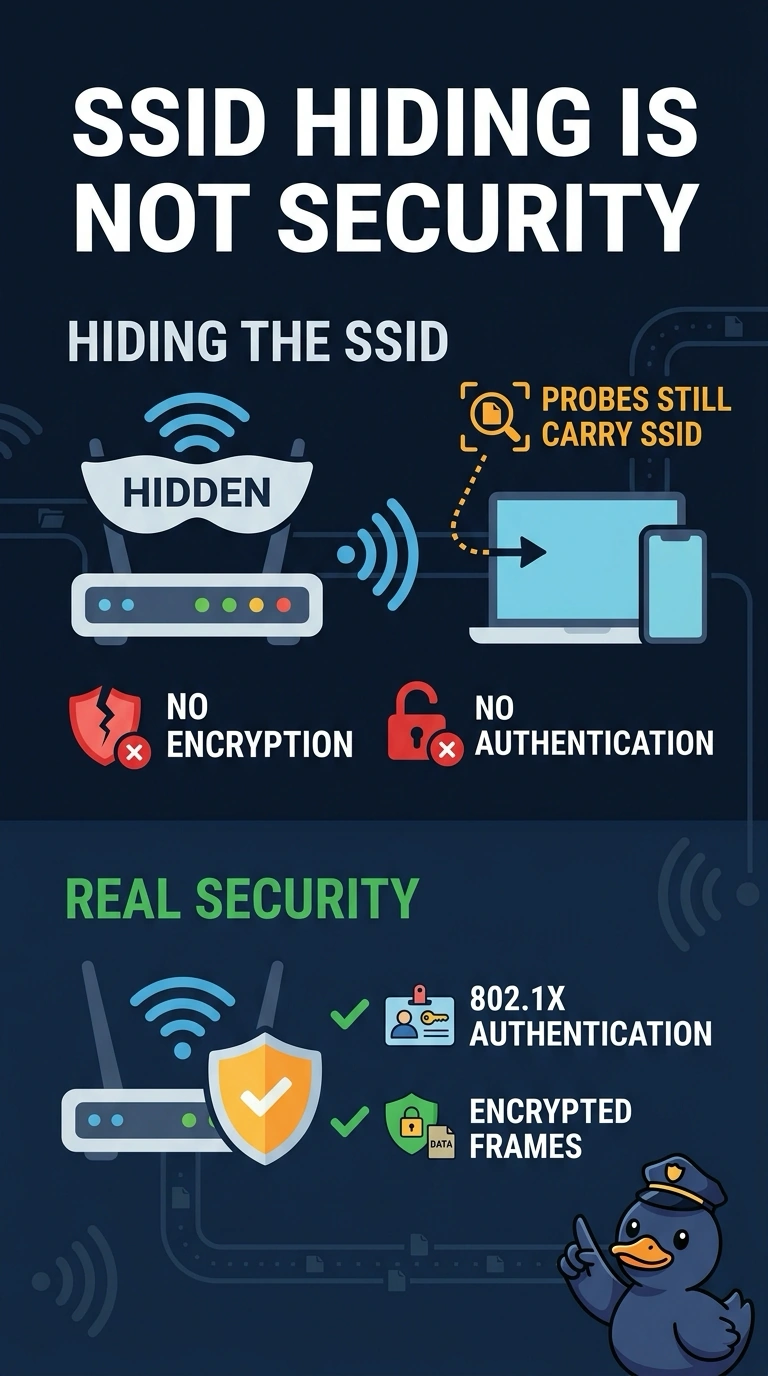
Taking the name off the beacon is not a lock. Your clients still ask for that name in probes, and with no passphrase and no 802.1X the frames stay readable. Put a real security method on the WLAN.
Full Explanation
A hidden SSID omits the name from beacons. Clients that know the name still put it in probe requests, so a capture reveals it, and the omission does not authenticate anyone or encrypt data. This warehouse configured no passphrase and no 802.1X, so the frames are readable. Hiding was never the control they needed. Hiding does not encrypt frames on any band, including 6 GHz. Readable data is the expected result of an open, hidden network, not a 6 GHz exception. Hiding is not 802.1X. There is no certificate in this design to expire, and 802.1X would show an EAP exchange rather than open data frames. Hiding also does not block probes. The capture that shows the name is exactly how a hidden network is found. Exam caveat: adding a passphrase or 802.1X is the fix. Leaving the network hidden after that is optional and usually makes roaming and support harder, not safer. Operational check: capture a probe from a client that has the network saved and confirm the name is visible, then enable a real security method and confirm data frames are no longer readable.