
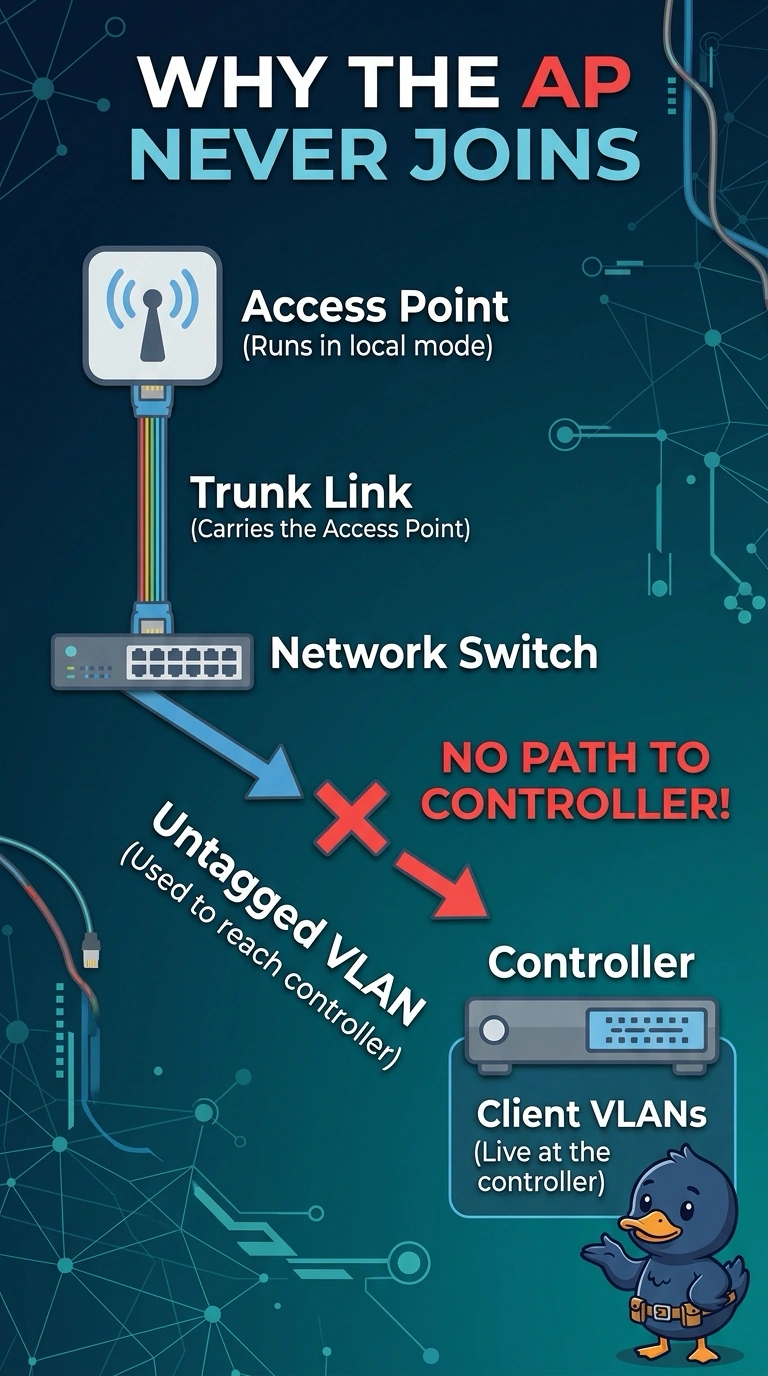
A local-mode access point is cabled to a trunk. Its untagged VLAN on that trunk has no path to the controller, and the access point never joins. Client VLANs are supposed to live at the controller. What is wrong?
Select an answer to reveal the explanation.
Short Explanation
The access point has to reach the controller before it can carry anyone. Your untagged VLAN on that trunk does not go there, so the join never starts. Client VLANs for this mode live at the controller, not on the access-point port.
Full Explanation
A local-mode access point tunnels client traffic to the controller and needs its own untagged management path to get there. On this trunk that untagged VLAN has no path to the controller, so the access point never joins. Client VLANs are not required on the access-point port in local mode. Trunking them there does not fix a management VLAN that cannot reach the controller. Making the port an access port in a client VLAN would put the access point in the client network, which is the wrong place for its join, and it still needs a path to the controller. Sniffer mode is a capture mode. It is not required for discovery on a trunk. Local mode does not need the client VLANs on the access-point trunk. It needs a management VLAN that can actually reach the controller. Exam caveat: if the native VLAN is the right one and a firewall still blocks the control ports, the join fails for a different reason. Confirm the VLAN and then the path. Operational check: put the access point's untagged VLAN on a network that can reach the controller and confirm the join, without adding client VLANs to the port.