
Local-mode clients never get an address. The access switch has a DHCP scope on the access-point VLAN, and the controller's client VLAN has no DHCP path. Where does a local-mode client actually request an address?
Select an answer to reveal the explanation.
Short Explanation
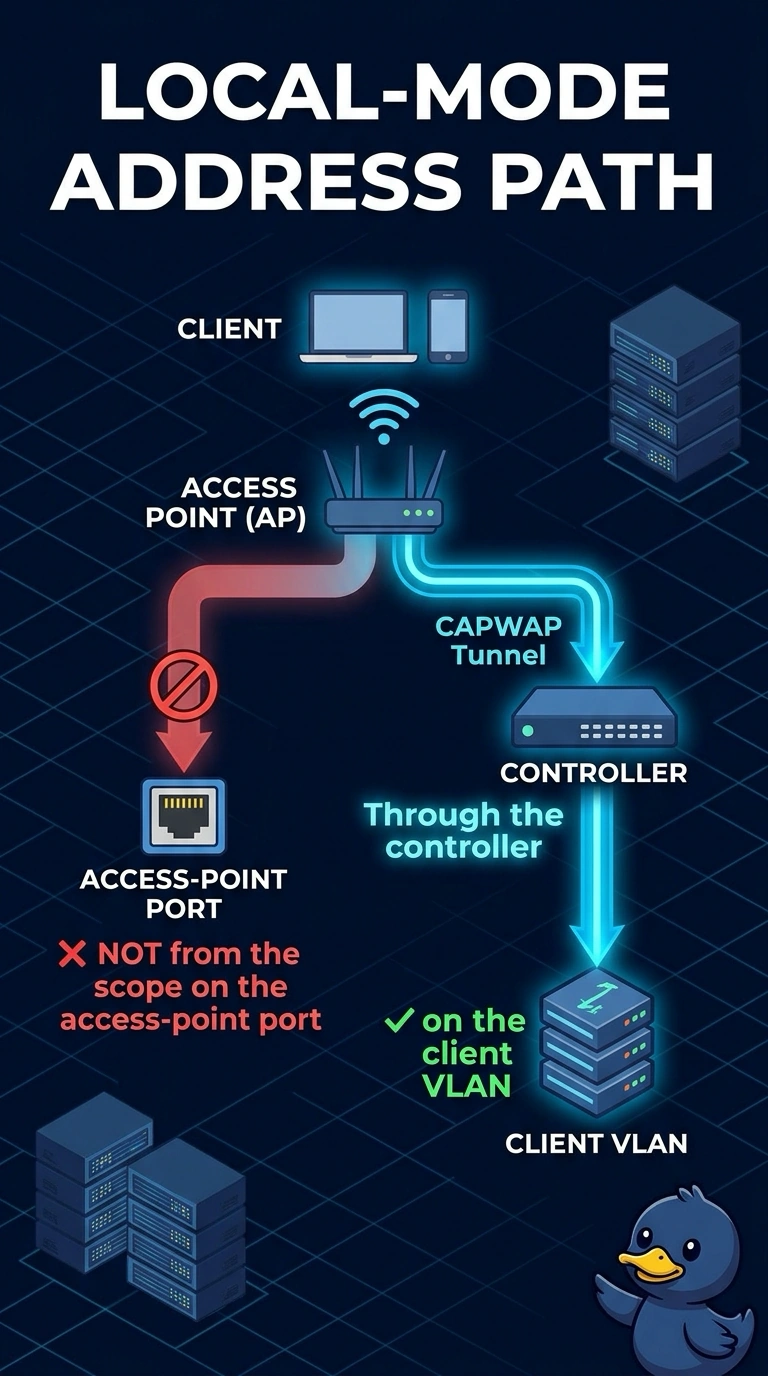
The scope you built is on the access point's own VLAN, and the clients are not sitting there. A local-mode client asks for an address through the controller, on the client VLAN. That path is the one that is missing.
Full Explanation
Local mode tunnels client traffic to the controller, and the client VLAN lives there. The DHCP request goes through the controller on that client VLAN. A scope on the access-point VLAN answers the access point, not the clients, which is why this scope does not help. The access point does not serve DHCP just because it is in local mode. The request is not a broadcast that stays on the access switch and skips the controller. The tunnel is the point of local mode. Local-mode clients get their addresses from DHCP reached through the controller, not from a scope the access switch has on the access-point VLAN. Check one live client after the change and do not retune the rest of the floor until that client matches the result you expected. Exam caveat: the controller still needs a real DHCP path on the client VLAN, a helper or a local server. Putting the scope in the right VLAN and forgetting the helper fails the same clients. Operational check: give the client VLAN a DHCP path, leave the access-point VLAN scope for the access points, and confirm a client receives a client-VLAN address.