
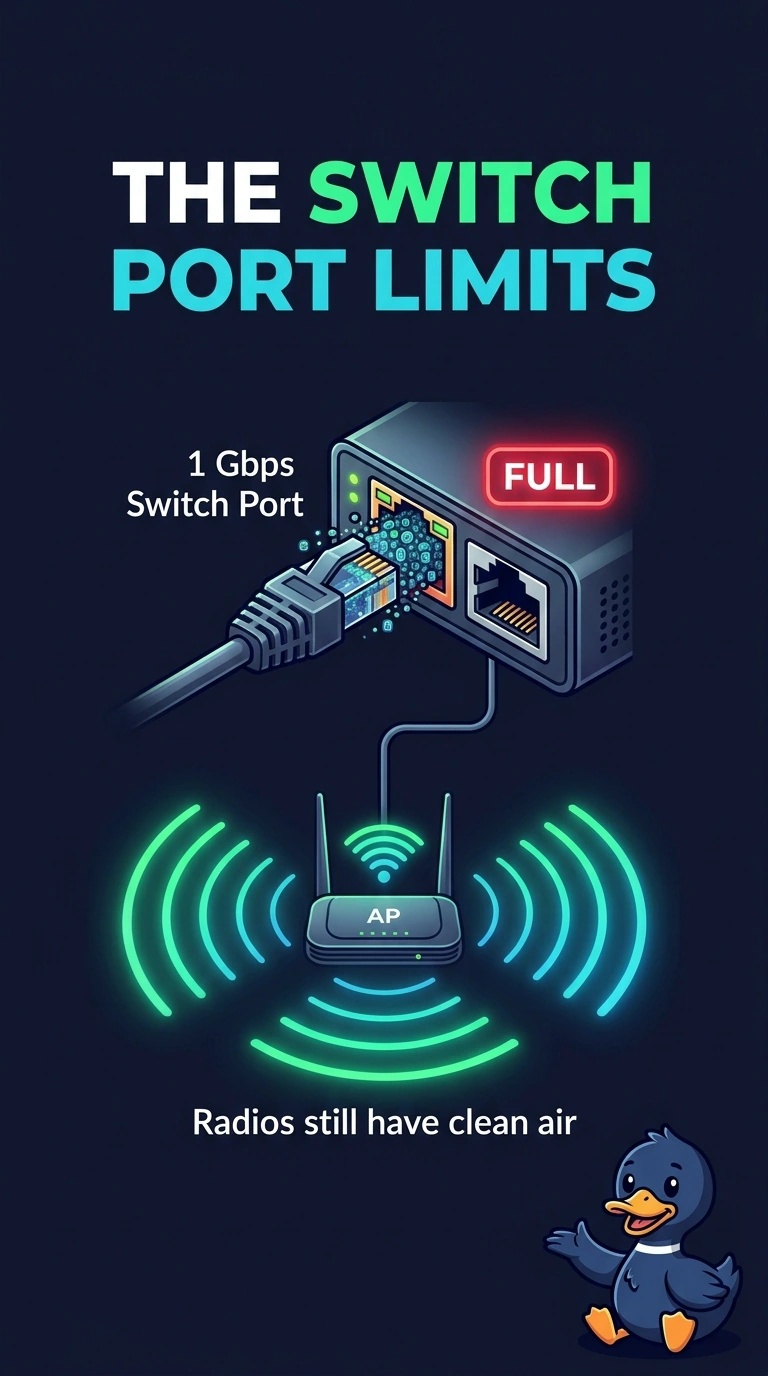
A lecture hall access point shows healthy client SNR and a 1 Gbps link to the switch that stays full while clients are busy. The access point and the cable can run faster than 1 Gbps. What is the limit?
Select an answer to reveal the explanation.
Short Explanation
The air looks clean and the wire is the part that is full. Your 1 Gbps port is the limit, not the noise floor. A faster beacon will not widen that port.
Full Explanation
When client SNR is healthy and the access-point uplink stays at a full 1 Gbps during busy periods, the wired port is the bottleneck. The access point and the cable can go faster, so the switch port that only offers 1 Gbps is the limit to remove, typically with a multigigabit port on both ends. A full Ethernet counter does not mean the channel is noisy. The SNR reading says the air is fine, and noise would show up as retries and a poor SNR, not as a pegged uplink beside a clean radio. The guest VLAN number is not made illegal by a full port. Saturation is a capacity fact, not a VLAN-ID check. The beacon interval does not fill a gigabit port. Beacons are small. A port fills because client data is crossing it, and spacing beacons differently will not add wired bandwidth. Exam caveat: both ends and the cable have to support the faster rate. A multigigabit switch port on a cable or access point that only links at 1 Gbps does not move the ceiling. Operational check: read the switch interface utilization and the negotiated speed, then move the access point to a faster port and confirm the link comes up above 1 Gbps while SNR stays healthy.