
A retailer's dashboard-managed access points lose contact with the dashboard for an hour. Clients are already associated and use locally bridged VLANs. What happens to that client data during the outage?
Select an answer to reveal the explanation.
Short Explanation
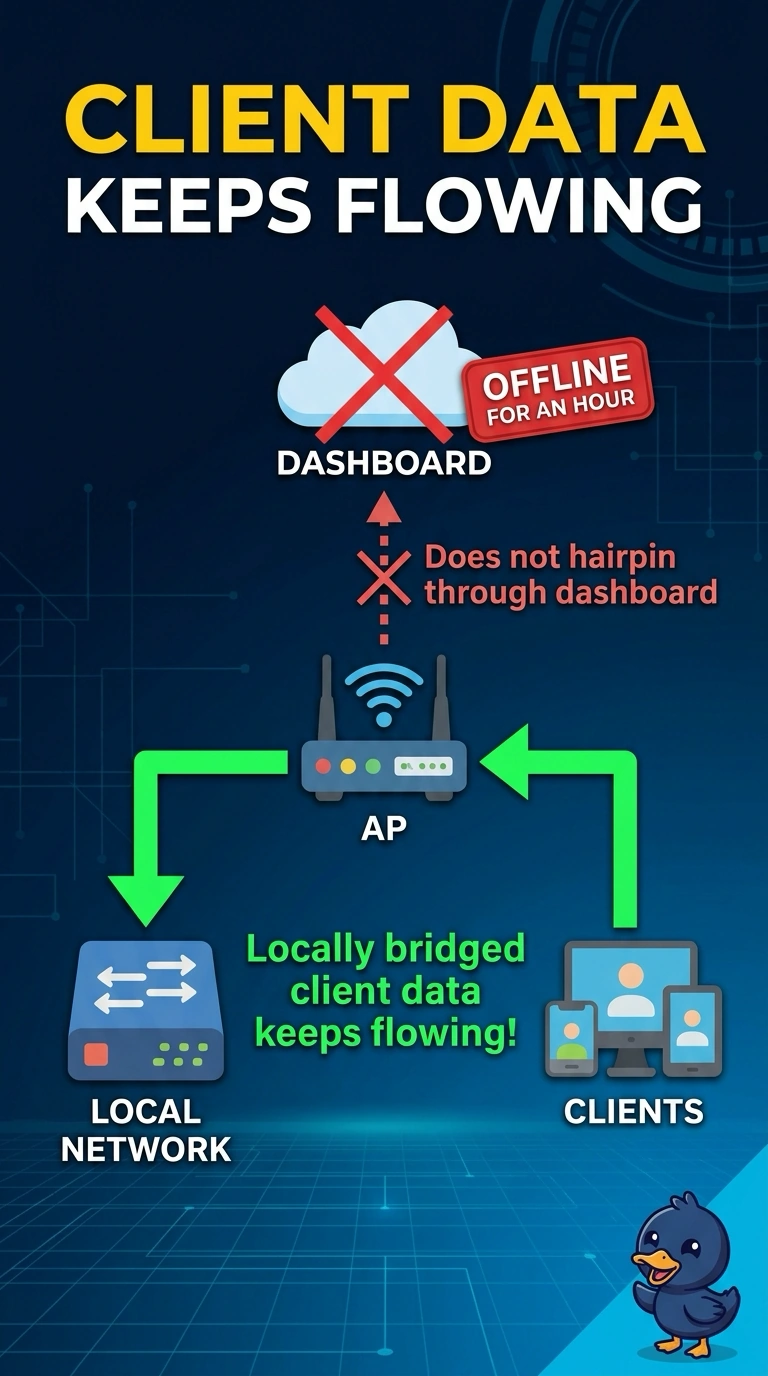
The dashboard is the management plane, not the pipe your store traffic rides. Locally bridged clients keep passing data when the dashboard is unreachable. They do not suddenly tunnel every frame to the cloud.
Full Explanation
Cloud dashboard wireless manages configuration and monitoring in the dashboard, and the usual data path bridges clients onto a local VLAN at the access point. An hour without dashboard contact blocks new configuration and some cloud-hosted services, and it does not hairpin already associated, locally bridged client data through the cloud. That data keeps flowing on the local network. The idea that every frame is tunneled to the dashboard describes a loss of the dashboard as if it were a CAPWAP data controller. That is the local-mode failure mode, not this architecture. Sniffer mode is an operator choice on a controller-based access point. A dashboard outage does not put store access points into sniffer mode. These access points also do not automatically join a Catalyst 9800 and start central switching because the dashboard was unreachable. They are dashboard-managed units, not a failover to a controller they were never claimed by. Exam caveat: a guest portal or a RADIUS server that lives only in the cloud can still break new logins during the outage. Existing locally bridged data is the piece that continues. Operational check: during a maintenance disconnect, ping a local gateway from an already associated client and confirm the data path stays up, then confirm a configuration change does not apply until the dashboard returns.