
A branch uses FlexConnect local switching, but the switch port toward each access point is an access port in only the access-point VLAN. Locally switched clients associate and never get an address. What does that port need?
Select an answer to reveal the explanation.
Short Explanation
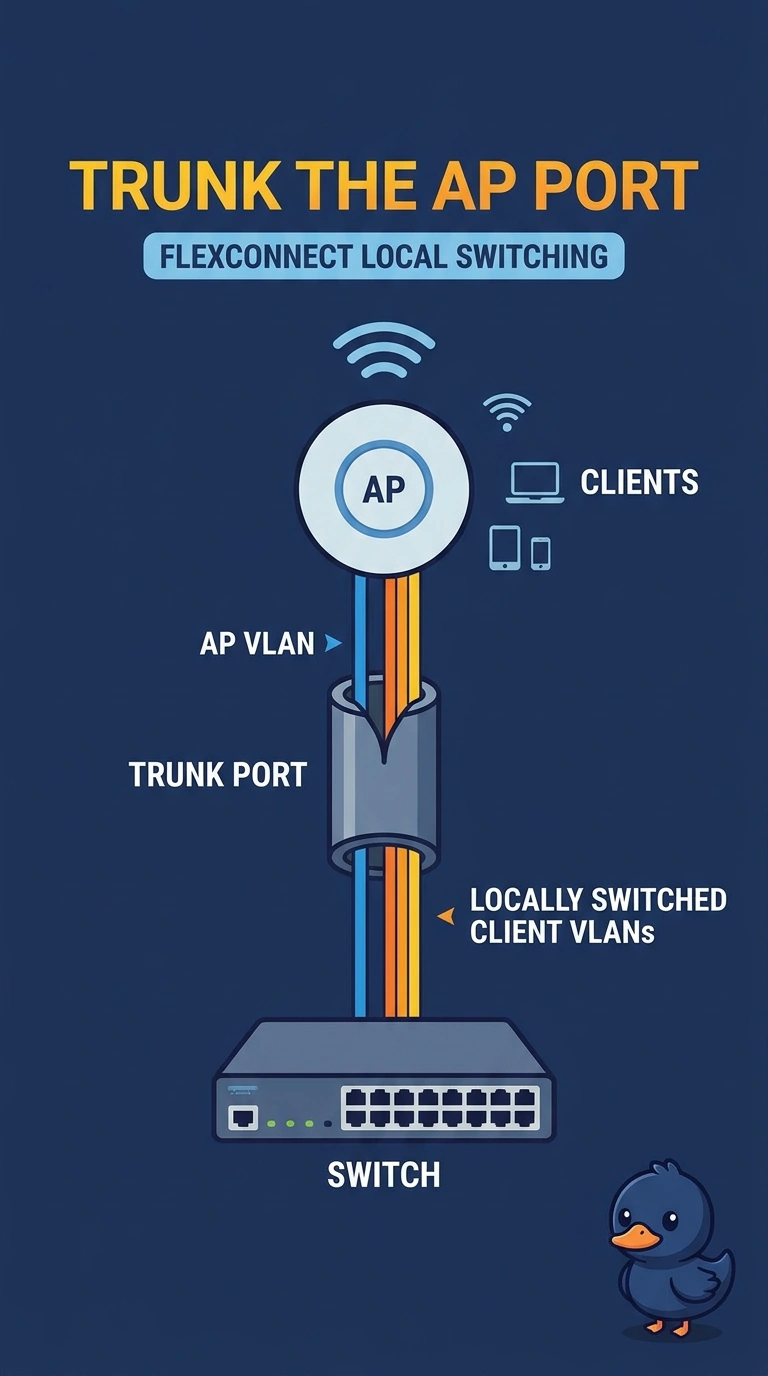
Local switching means the client VLAN has to be on the wire at the access point, not only in a far-away controller. Your port is an access port in the access-point VLAN, so the client VLAN was never invited. The trunk is the missing door.
Full Explanation
FlexConnect local switching bridges client traffic onto a VLAN at the branch. That VLAN has to be present on the link to the access point, which means a trunk that allows the client VLANs plus the VLAN the access point itself uses. An access port in only the access-point VLAN can bring the access point online and still give locally switched clients no VLAN to join, so they associate and never get an address. Disabling PoE would power the access point off. Local switching does not move DHCP onto spare pairs, and these access points are already associating clients, so they have power. A routed port with no VLAN removes the Layer 2 client networks the access point is supposed to bridge onto. The WAN address is not the gateway for those locally switched VLANs. A monitor session copies frames for analysis. It does not create a client VLAN or teach the access point which VLAN to bridge. Exam caveat: the WLAN also has to be set for local switching and mapped to the right VLAN in the Flex profile. A trunk that carries a VLAN the profile never names still will not be used. Operational check: confirm the port is a trunk, the client VLAN is allowed, and a test client receives an address from that branch VLAN.