
A single nurse's handset at a hospital fails to connect to the clinical WLAN. The engineer wants that client's events from the Catalyst 9800, without enabling a debug of every client on the controller. Which monitoring approach fits?
Select an answer to reveal the explanation.
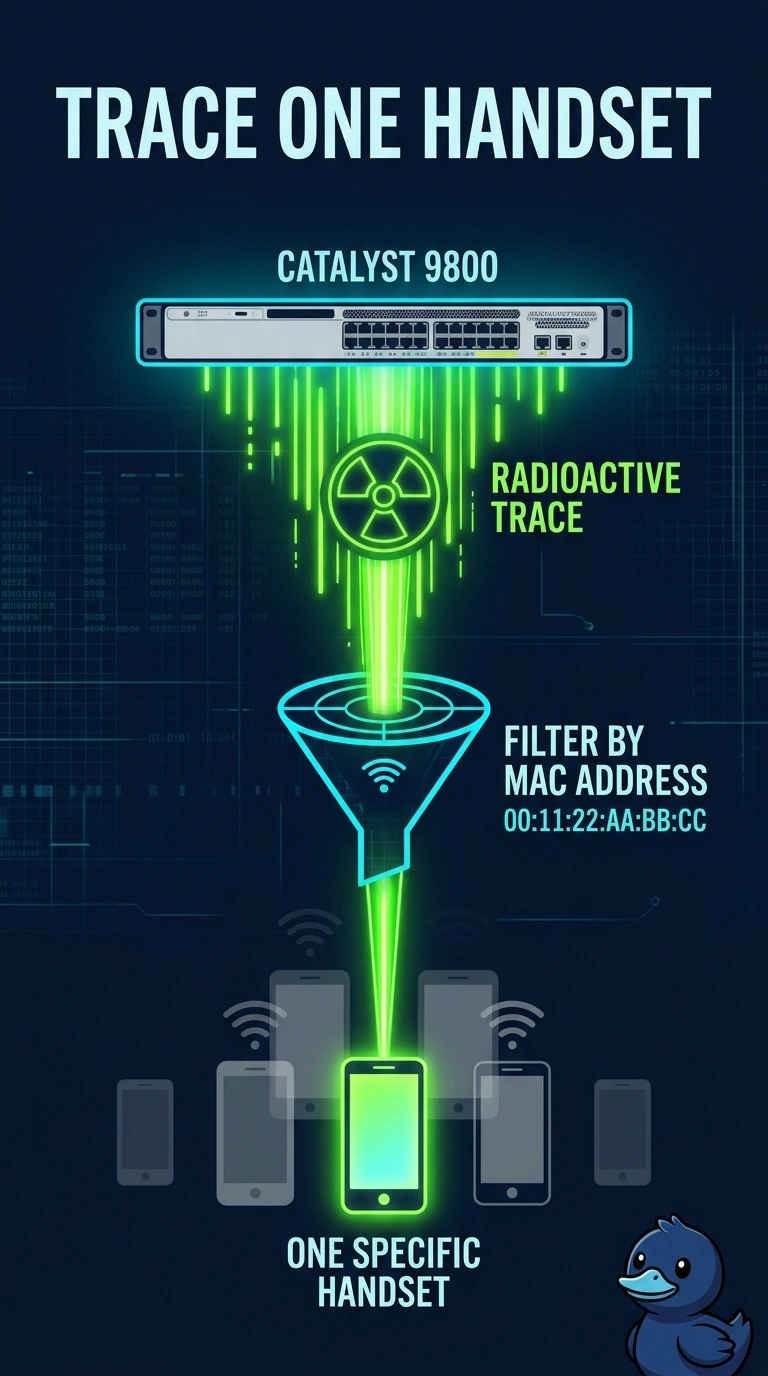
Short Explanation
You want one patient's chart, not a reboot of the hospital. A radioactive trace follows the handset you name and leaves everyone else's debug off. Reloading the controller to get a clean log is how you create a second outage.
Full Explanation
Radioactive tracing on a Catalyst 9800 collects a filtered trace for a condition you set, commonly the client MAC address, and shows that client's state changes without turning on a controller-wide client debug. For one known handset that fails to connect, it is the monitoring tool that matches the scope. A reload clears volatile buffers and drops every client. It does not add detail about the next attempt, and it is an outage, not a monitoring method. Sniffer mode on every floor would take those access points out of client service and produce channel captures, which is far wider than one handset and does not by itself stitch the controller's client state machine. Deleting the clinical WLAN removes service for every nurse so you can read an audit of the deletion. The audit shows a configuration change, not the association or authentication failure of the handset. Exam caveat: start the trace, then reproduce the failure. A trace that was not running during the attempt cannot reconstruct it. Operational check: filter on the handset MAC, reproduce the connect once, and read the trace for the last state that failed before you change the WLAN.