
After a brief WAN blip, a clinic controller marks its only RADIUS server dead. New 802.1X clients fail until the dead timer ends, and there is no second server. What should be added?
Select an answer to reveal the explanation.
Short Explanation
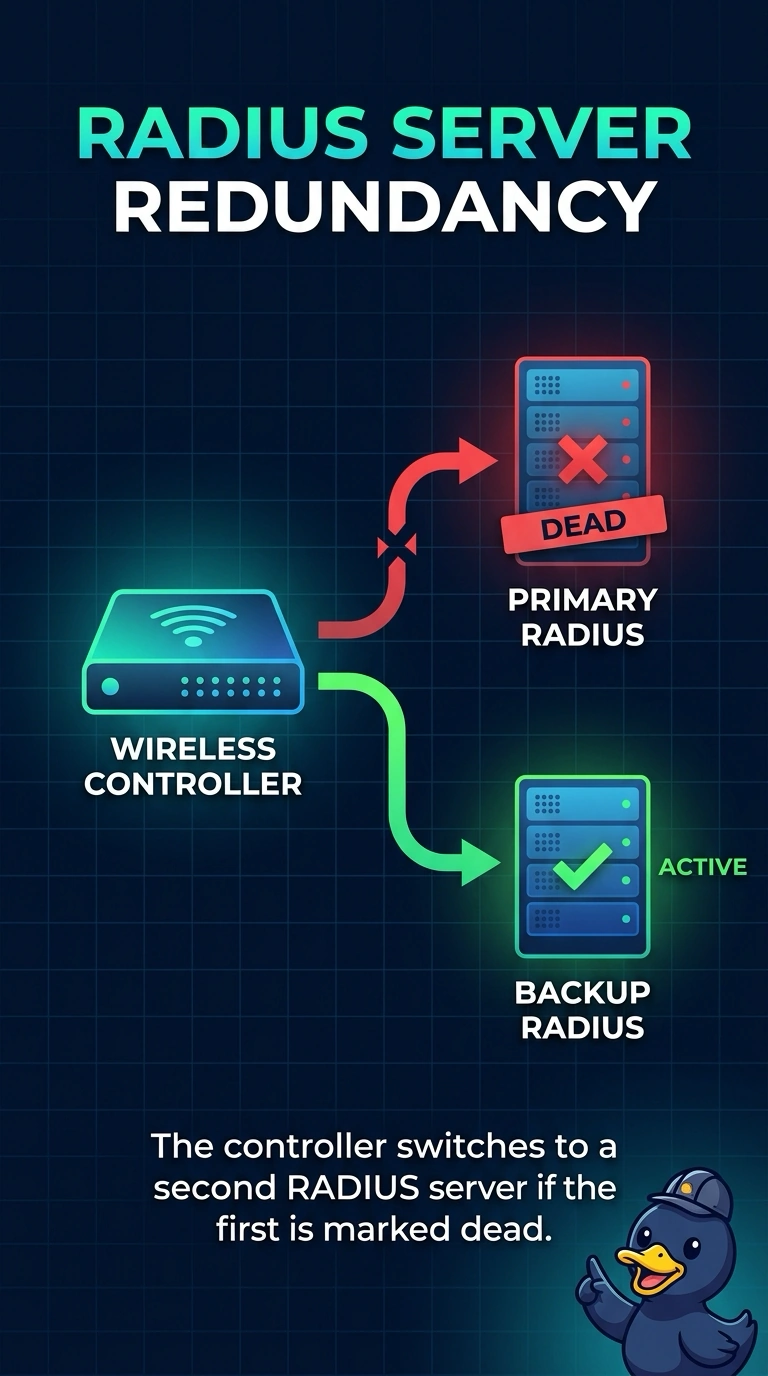
When your controller marks its only RADIUS server dead, new clients cannot authenticate until the dead timer ends—even if the WAN blip has passed. Add a second RADIUS server so your controller has another place to send authentication requests.
Full Explanation
When a RADIUS server stops answering, the controller marks it dead and will not send new authentication requests to it until the dead timer expires. With only one server, new 802.1X clients fail during that interval, even if the WAN blip has already ended. A second RADIUS server gives the controller another place to send requests while the original server is marked dead. A hidden SSID does not revive or replace a RADIUS host. A faster beacon changes beacon timing; it is not an authentication server or a backup for one. A lower data rate affects wireless association, but it does not keep a dead RADIUS server in service; the clients are failing authentication, not a mandatory rate. Exam caveat: configure the controller as a network device on the second server, apply the same policies, and ensure its path does not fail with the first server’s WAN connection. A second server address on the same failed link is not a backup. Practical check: take the original server offline in a test and confirm that a new laptop receives an Access-Accept from the second server.