
A lab WLAN uses MAC filtering as its only control and calls that authentication. A tester sets a laptop to an allowed MAC address and joins with no credentials. What did the filter fail to do?
Select an answer to reveal the explanation.
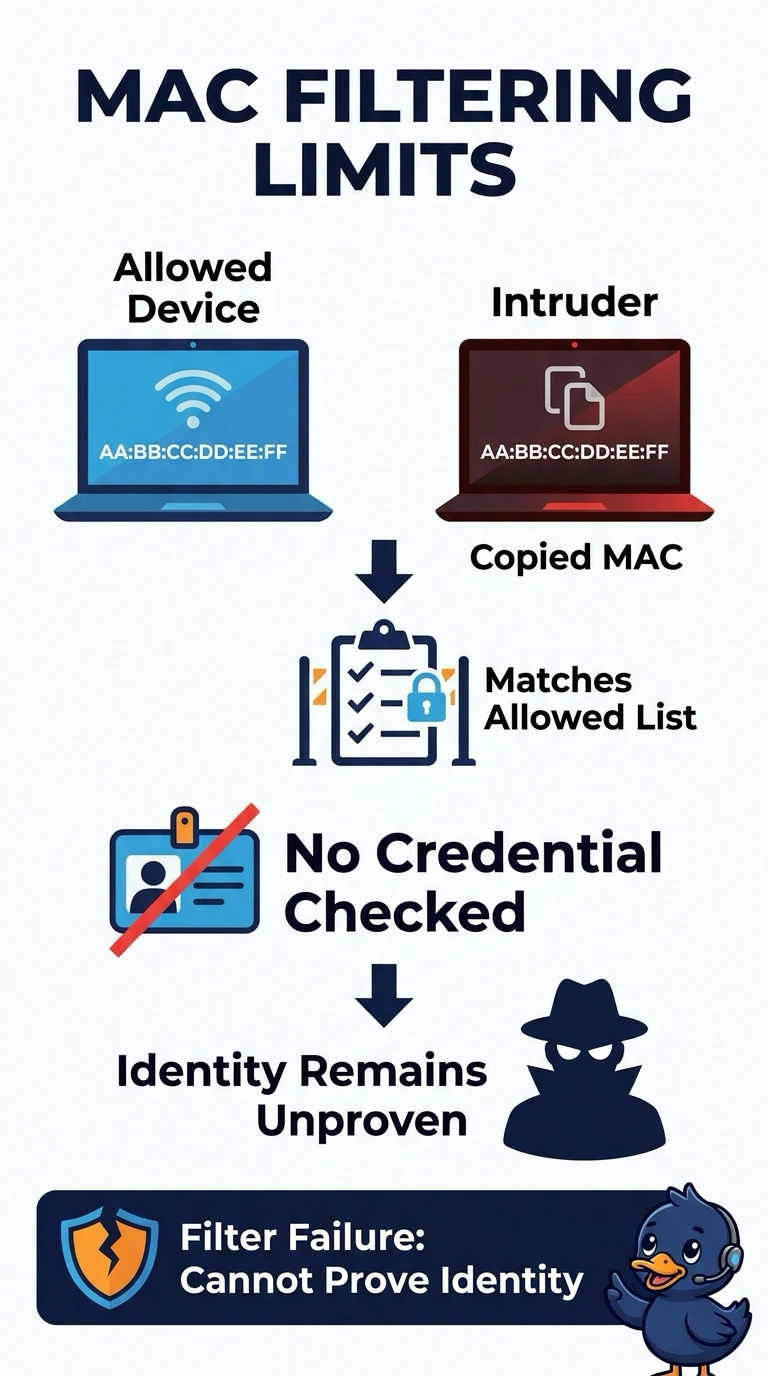
Short Explanation
A list of MAC addresses is a guest book, not a badge check. Your tester wrote down an allowed address and walked in with no credential. That is why the filter never proved who they were.
Full Explanation
MAC filtering compares the source address with a list. It does not ask for a password, a certificate, or any secret the tester cannot copy. Setting a laptop to an allowed address satisfies the list, so the filter never proved identity. That is the failure. The filter does not encrypt anything, and it is not a passphrase stored in a beacon. Beacons are readable, and an address list is not a key. An allowed MAC address does not select a channel. Channel selection is an access-point radio decision, unrelated to whether the address was on a list. MAC filtering is also not EAP-TLS. EAP-TLS uses certificates. Treating the address as a key confuses a spoofable identifier with a credential. Exam caveat: a MAC list can still be a useful allow or deny hint on top of real WLAN security. Alone, it is not authentication. Operational check: with the filter as the only control, change a test laptop to an allowed address and confirm it joins, then add 802.1X or a passphrase and confirm the copied address is no longer enough.