
Voice handsets on a campus WLAN cannot use 802.11r, and each roam still runs a full EAP exchange. The access points are on one controller. Which feature avoids that full exchange without 802.11r?
Select an answer to reveal the explanation.
Short Explanation
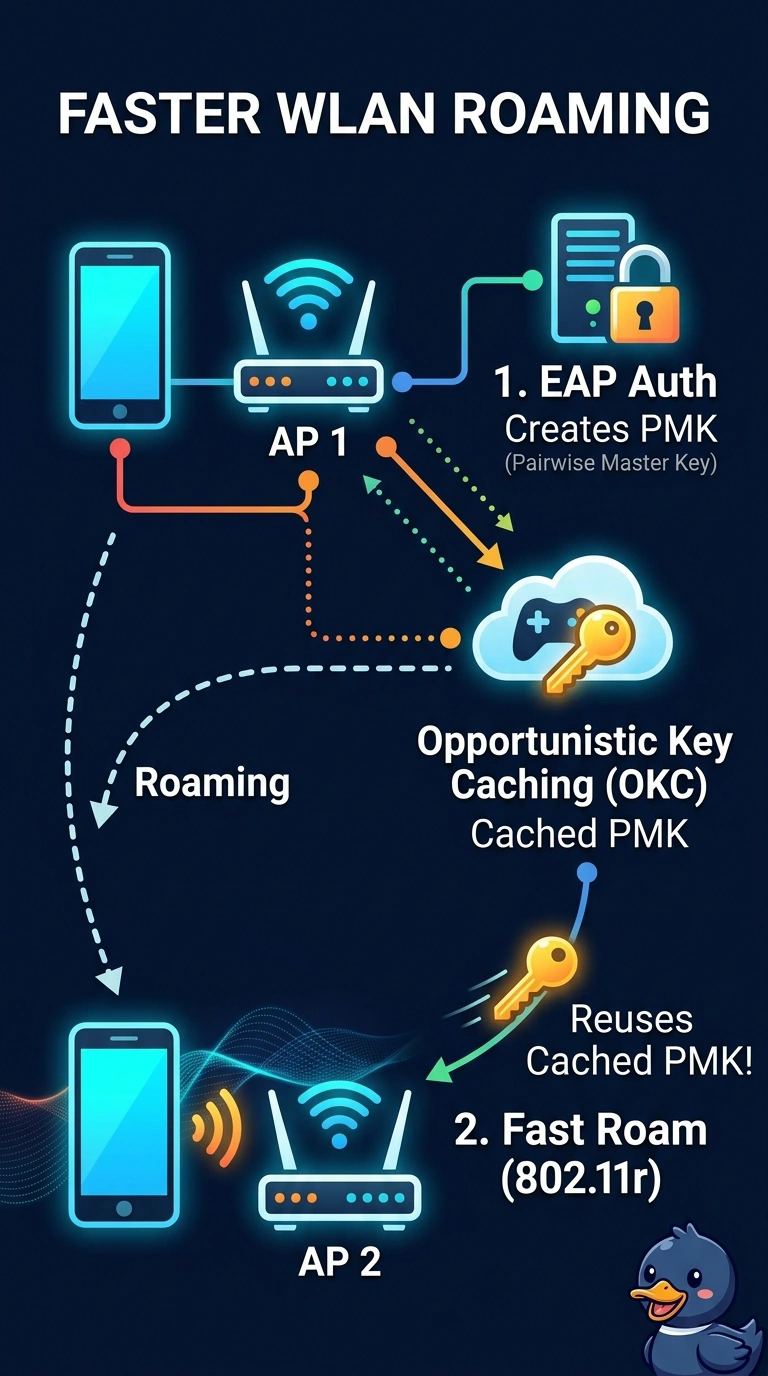
These handsets cannot do fast transition, and they are still paying for a full login at every access point. Opportunistic key caching lets your roam reuse the key from the first login. Hiding the network does not store that key.
Full Explanation
Opportunistic key caching lets a client and the controller reuse the pairwise master key from the first authentication when the client roams to another access point that can retrieve that key. On a single controller this avoids a full EAP exchange even when the handsets do not support 802.11r. A hidden SSID does not cache keys and does not display a key on the handset. It only changes whether the name is in the beacon. A new VLAN on every roam is a Layer 3 break. It forces new forwarding and often a new address, and it does not skip EAP. It adds disruption. Open authentication removes the security that EAP and the key cache are for. It does not keep EAP while deleting the cache. Turning security off is not a roaming feature. Exam caveat: the client has to support opportunistic key caching too. A handset that always starts a fresh EAP exchange will ignore the cache, and the RADIUS log will still show a full success on every roam. Operational check: roam a test handset and confirm the RADIUS log does not show a new full EAP success on the second access point.