
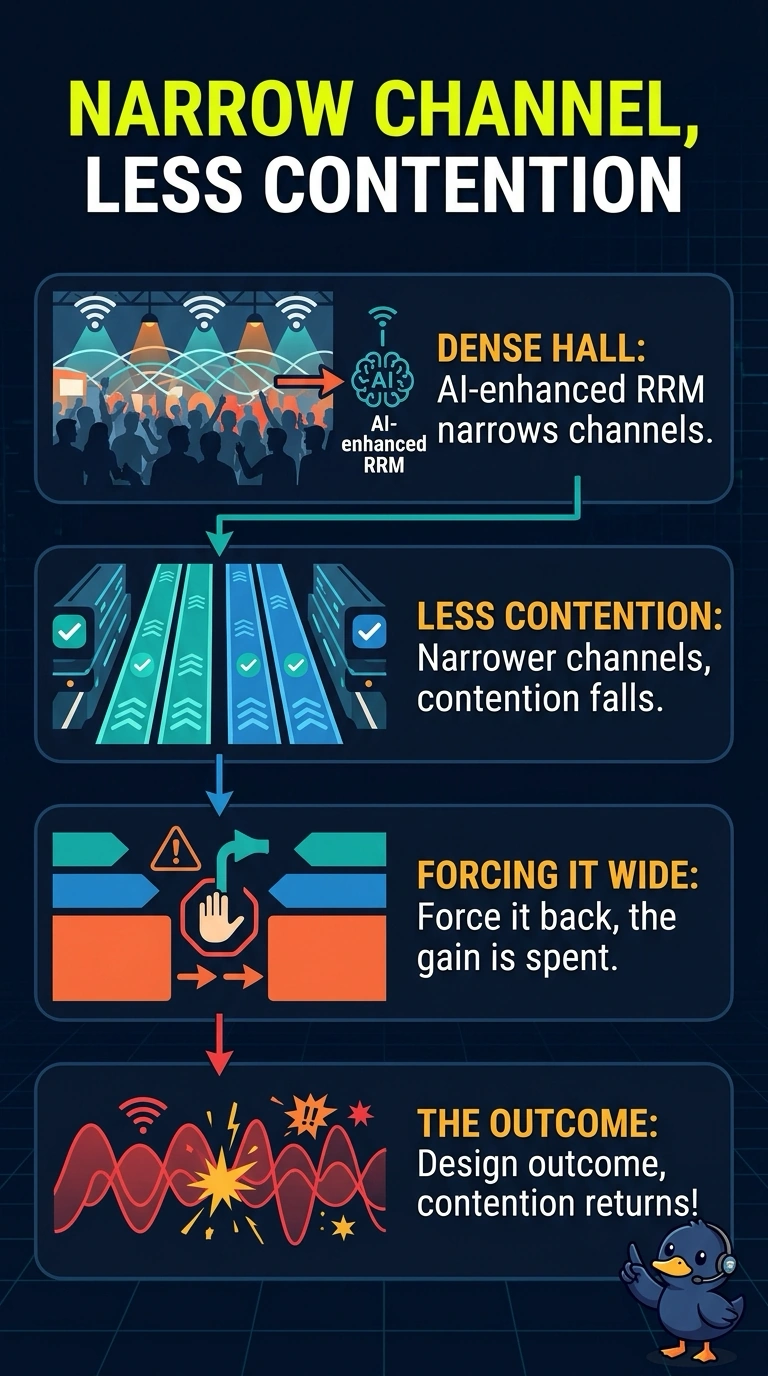
AI-Enhanced RRM narrowed a dense hall from a wide channel to a narrower one, and contention fell. An engineer forces the wide channel back and contention returns. What did the narrow channel accomplish?
Select an answer to reveal the explanation.
Short Explanation
The wide channel was sharing too much of the band with too many neighbors. The narrower one gave your hall some of that room back, and contention fell. Forcing the wide channel on again spends the gain, and a VLAN did not get quieter.
Full Explanation
Channel width is a trade. A wider channel can carry more and it also overlaps more neighbors and collects more energy. AI-Enhanced RRM narrowed this dense hall and contention fell. Forcing the wide channel back undoes that and the contention returns, which is what the engineer observed. The narrow channel did not disable the radios. Clients were still there, with less contention. It did not change the guest VLAN. Contention on the air is not a VLAN. It did not revoke the country code, and a wide channel is not how a country is restored. AI-RRM narrowed an 80 MHz channel because the hall was dense. Forcing 80 MHz back restores the contention the narrower width was avoiding. Exam caveat: coverage-hole detection stays on the controller and can still raise power locally. A narrower channel is not a promise that a far corner kept its signal. Check the edge of the hall after the width change. Operational check: leave the narrower width, confirm contention stays down, and measure the far seats before you force the wide channel again.