
A campus has heavy co-channel contention and, separately, a DHCP scope that is exhausted. Which of those problems does AI-Enhanced RRM take on?
Select an answer to reveal the explanation.
Short Explanation
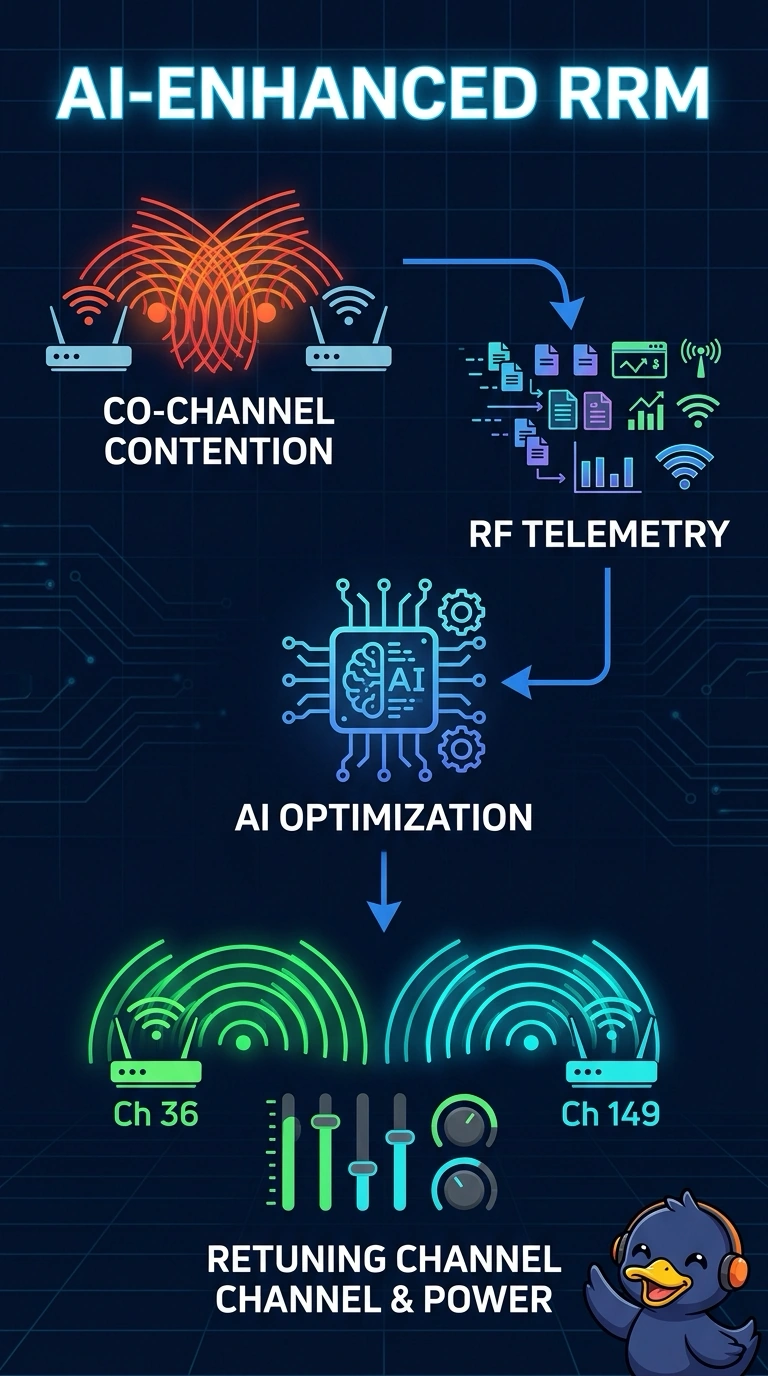
AI-Enhanced RRM is an RF tuner, not a DHCP server. It can take on your co-channel mess by moving channel and power. An empty scope still needs a scope, and renaming an SSID is not the feature.
Full Explanation
AI-Enhanced RRM analyzes RF telemetry and returns channel and power decisions, including the co-channel problem DCA is meant to reduce. The exhausted DHCP scope is a separate failure. AI-Enhanced RRM does not issue addresses, so the problem it takes on here is the contention. An exhausted scope is fixed by growing the pool, shortening wasteful leases, or adding a VLAN, none of which are RF algorithms. It also does not repair a scope as a side effect of channel assignment. A client on a clean channel with no remaining addresses still gets nothing. And AI-Enhanced RRM is not an SSID rename tool. SSID names live in the WLAN configuration, not in the RF optimization loop. Exam caveat: a better channel does not excuse a full DHCP pool, and a fixed pool does not excuse a floor where every access point sits on one channel. They are two work items. Operational check: confirm the site is enrolled for AI-Enhanced RRM and that channel changes show up for the noisy radios, and fix the DHCP scope on its own ticket.