
Three access points advertise the same SSID and clients roam among them. There is no controller. A design note calls this an independent basic service set. What is it actually?
Select an answer to reveal the explanation.
Short Explanation
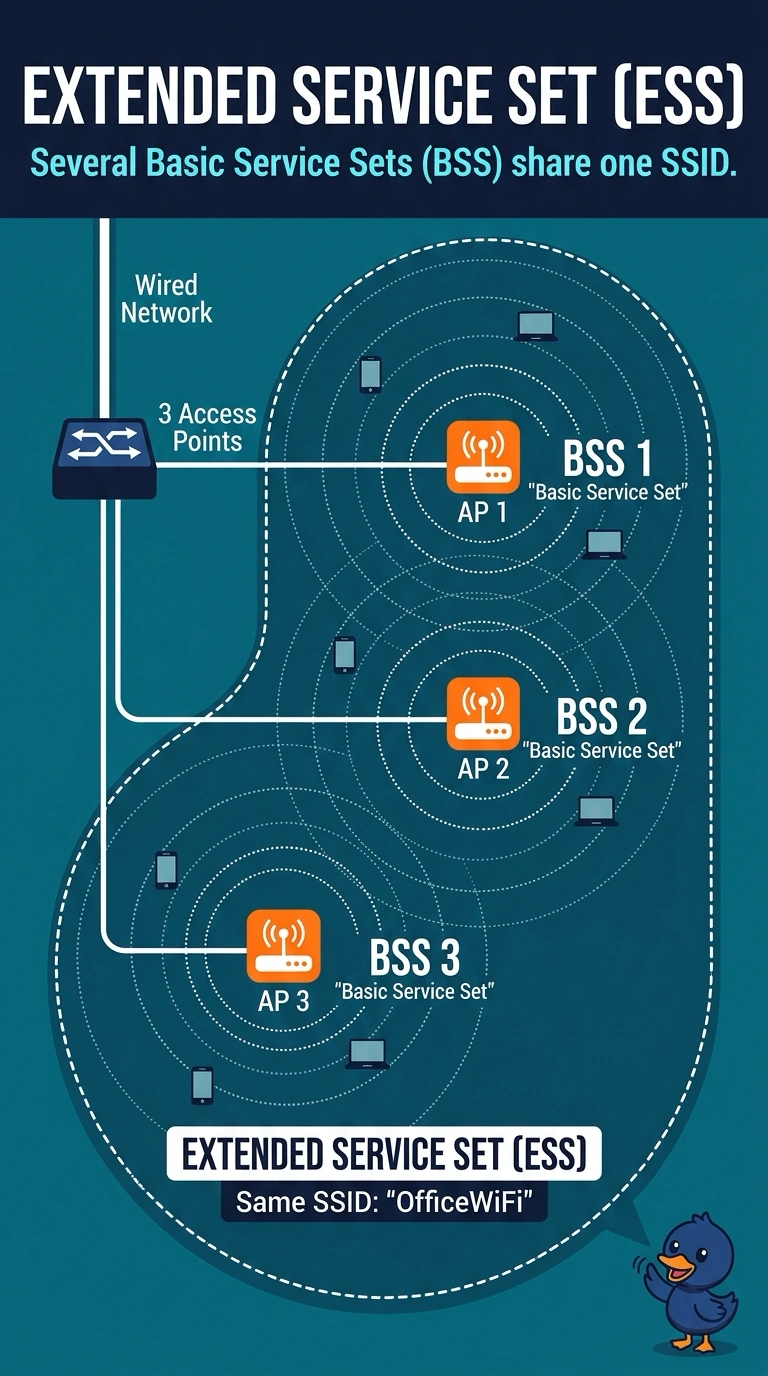
Three cells, one name, clients walking between them. That is an extended set, whether or not you own a controller. Your note used the name that belongs to a handful of stations talking with no access point at all.
Full Explanation
A basic service set is one access point and its clients. An extended service set is two or more of those sets under the same SSID, which is what these three access points are. Clients roaming among them is the ordinary ESS behavior. An independent basic service set is stations associating with each other and no access point. The lack of a controller does not create one. A controller is a management choice, not part of the definition. A roam between access points is not a mesh hop. Mesh is a wireless backhaul to a root. One SSID is allowed on many access points. That is the extended set, not a violation of a one-access-point rule. Several access points advertising one SSID are an extended service set. The absence of a controller does not turn that into an IBSS. Exam caveat: the SSID has to be the same and the security has to be compatible or the client will treat the next access point as a different network and do a full join. Operational check: roam a client across two of the access points and confirm it keeps the SSID and does not fall back to an ad hoc network.