
A retailer copies the 2.4 GHz transmit settings onto new 6 GHz radios in the same country and assumes the copy is legal. What is wrong with that assumption?
Select an answer to reveal the explanation.
Short Explanation
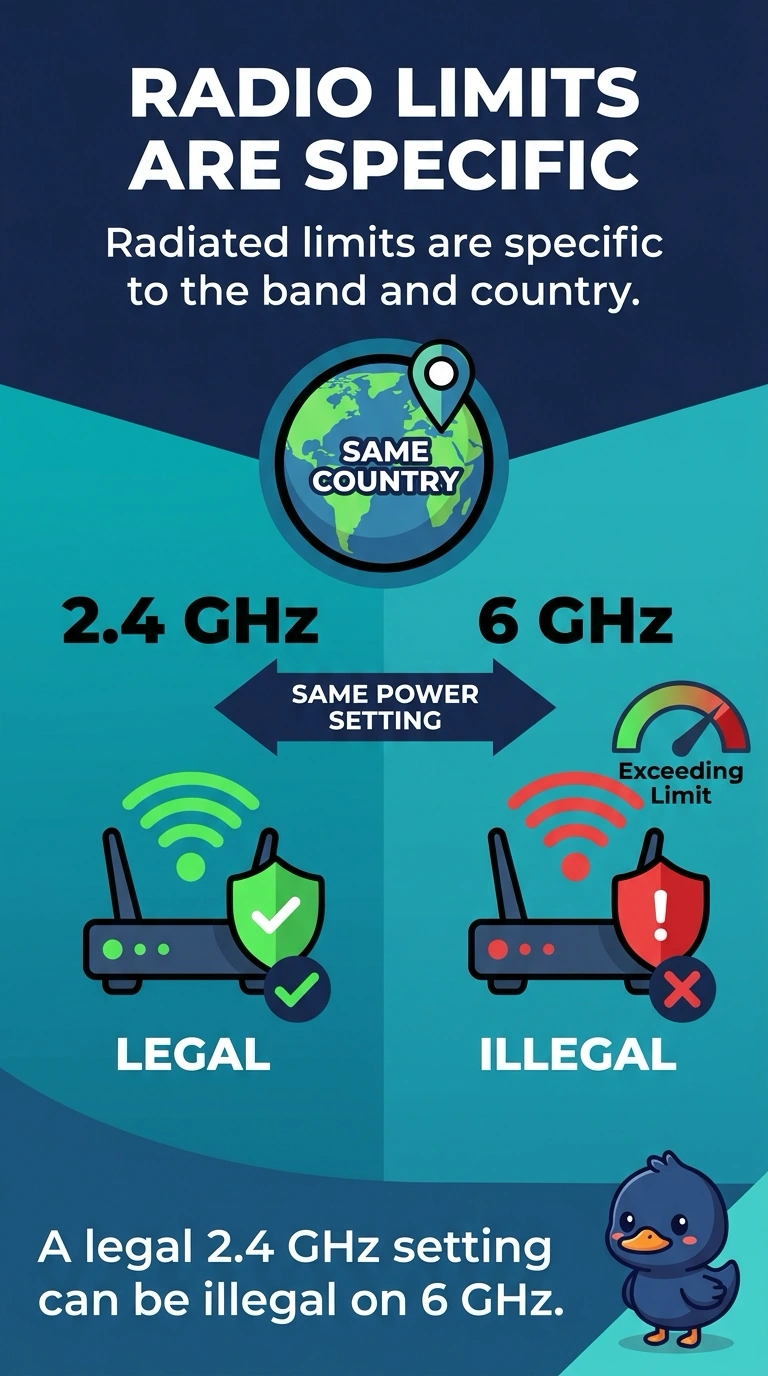
Legal on one band is not a coupon for the next band. Your 2.4 GHz setting can be too hot, or pointlessly low, once it is copied onto 6 GHz. The country and the band both belong in the sum.
Full Explanation
Radiated limits are written per country and per band, and often per channel width and indoor or outdoor use. A 2.4 GHz setting that is legal does not travel onto 6 GHz unchanged. Copying it can exceed the 6 GHz limit or leave a legal margin unused. The assumption that the copy is automatically legal is the mistake. The claim that 6 GHz matches 2.4 GHz in every country is the same mistake. The Wi-Fi Alliance certifies interoperability. It does not publish the country's power cap, and the country does matter. RRM chooses among the powers the regulatory configuration allows. It does not ignore the country limit on 6 GHz and climb until roaming breaks. Copying a conducted setting across bands skips the country rule for the new band. The legal check is the radiated result on 6 GHz. Exam caveat: antenna gain still counts. A conducted setting that looks legal becomes illegal EIRP after a high-gain antenna. Check the radiated total, not only the number on the radio. Operational check: compare the 6 GHz EIRP you would actually radiate with the country's 6 GHz rule before you leave the copied setting in place.