
During a wide area outage a hospital phone registers to the local Survivability Gateway and can place basic internal calls. An admin wants to open a fault against the cloud registration while that path is still down. How should this registration be treated?
Select an answer to reveal the explanation.
Short Explanation
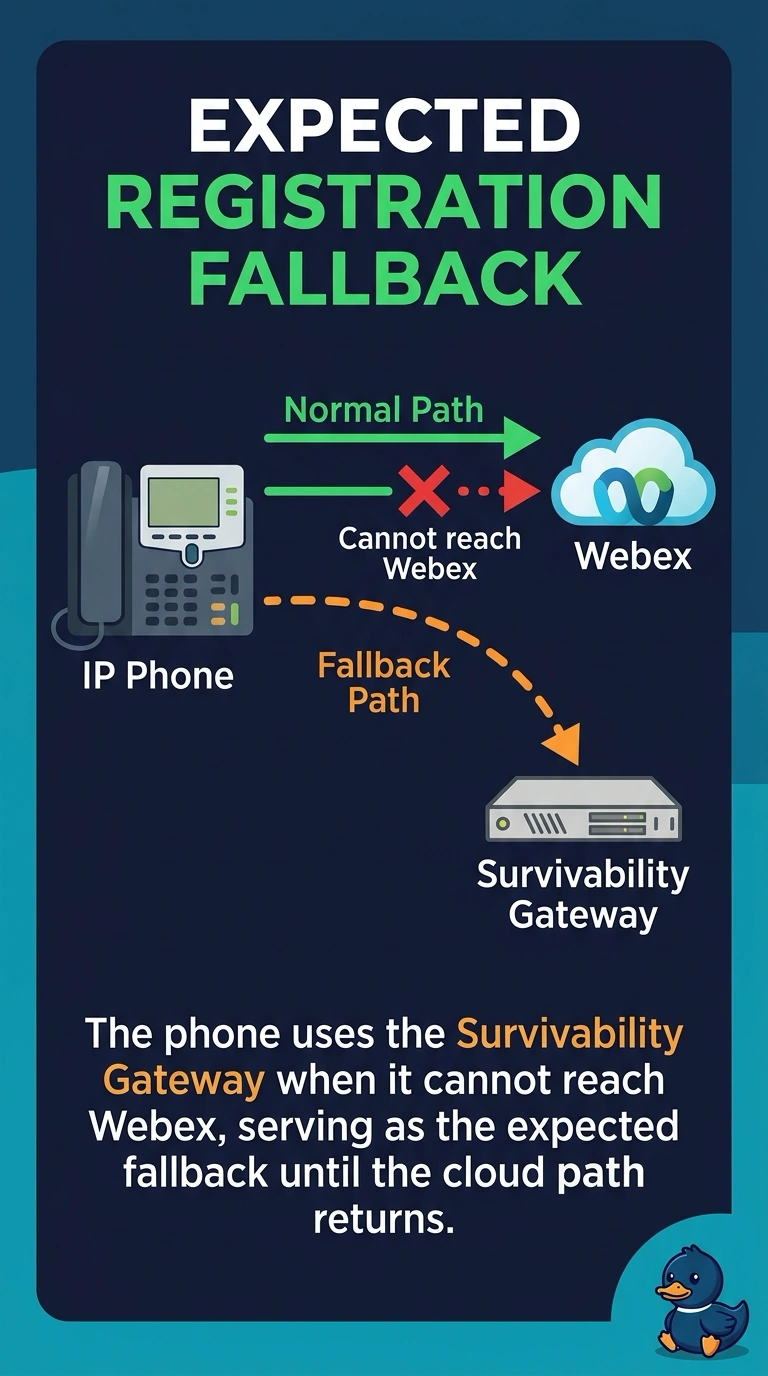
When the highway closes, you take the signed detour, and that detour is not a broken car. A phone on the Survivability Gateway during an outage is the expected fallback until the cloud path returns. Opening a cloud-registration fault while that path is still down misreads a backup that is doing its job.
Full Explanation
Phones normally register to Webex. When that path fails they register to a Survivability Gateway on the local network and get basic backup calling, including internal calls built from the sync. This hospital phone is in that state while the wide area path is down, so the registration is the expected fallback until the cloud path returns. Treating it as a local gateway trunk registration mixes two jobs. The Survivability Gateway is not the same object as the trunk that carries ordinary cloud calls, even when both can sit on one gateway. Treating it as a failed cloud claim to activate again now is the wrong reading. A Survivability Gateway registration does not mean the phone was never added to this organization. It means the cloud path is unavailable. Treating it as a dial-plan fault assumes a translation pattern moved the phone. A translation rewrites digits. It does not move a phone from Webex onto the Survivability Gateway. Exam caveat: call control returns to Webex only after the cloud path has been back, so a fallback registration during the outage is still normal. Operational check: confirm the wide area path is still down, confirm basic internal calls work through the Survivability Gateway, and recheck cloud registration only after that path is restored.