
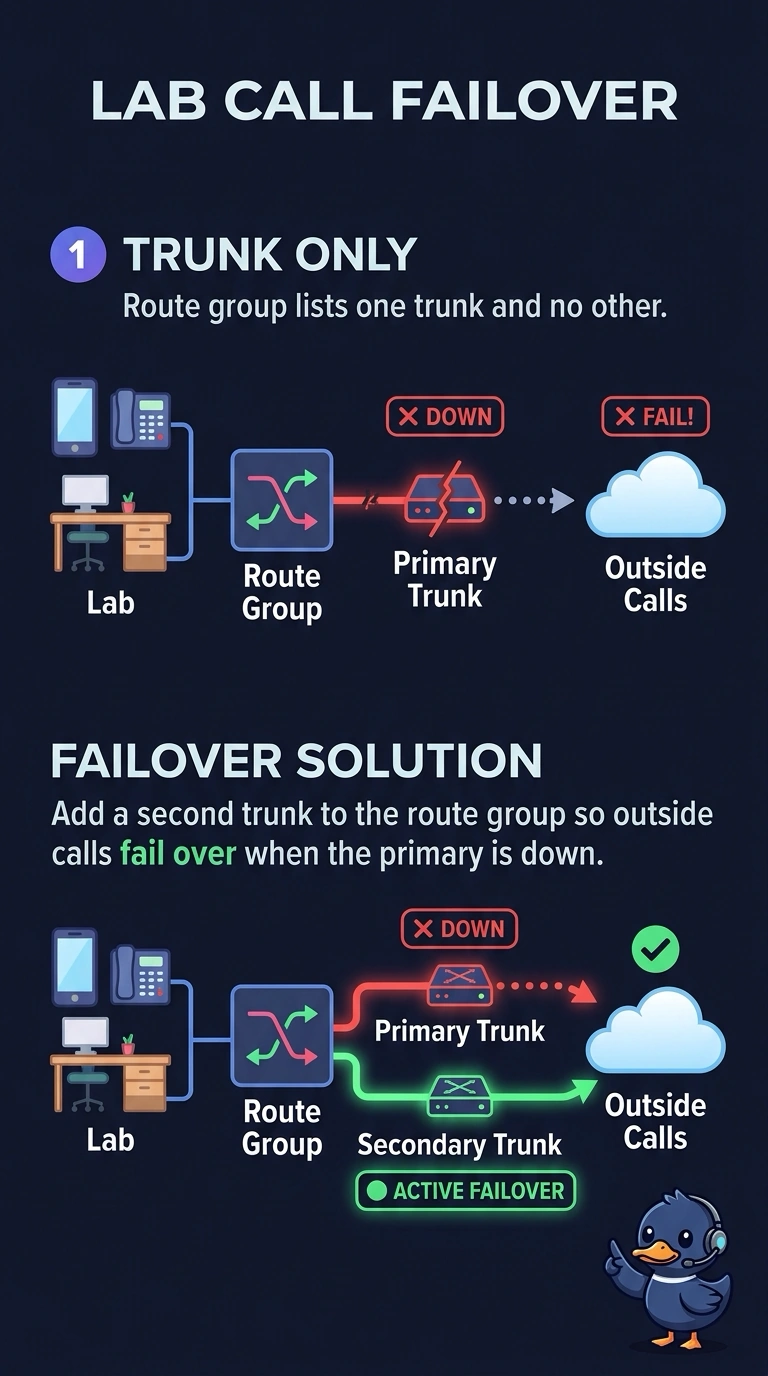
A research lab loses outside calls only while the primary trunk is down. The route group for those calls lists that one trunk and no other. Which change addresses the outage?
Select an answer to reveal the explanation.
Short Explanation
A single bridge with no side road stops every trip the moment that bridge closes. You add a second trunk to the route group so outside calls fail over when the primary trunk is down. The trap is building an auto attendant or a wider call permission and expecting that to stand in for a trunk.
Full Explanation
A route group is an ordered set of trunks used for capacity and failover. This group lists only the primary trunk, so outside calls fail when that trunk is down. You add a second trunk to the route group so outside calls fail over when the primary trunk is down. Building a new auto attendant with business-hours and holiday menus so the menu itself replaces the trunk that is down creates a call menu, and an auto attendant does not replace a trunk. Editing a translation pattern so digit rewrite keeps the call going when the only trunk in the route group is unavailable rewrites digits and does not choose a trunk or invent a second path. Raising every lab user to international call permission so the permission allows the call with no additional trunk changes whether a call type is allowed, and a permission does not carry the call when the only trunk is down. On the exam, failover for a trunk belongs in the route group, and a new auto attendant is not a spare trunk. In operations, during a maintenance window take the primary trunk down and confirm outside calls use the second trunk in that route group.