
A hotel wants callers who reach the main number to spell a staff name and be transferred to that person. Internal call permissions already allow those transfers. Where should dial-by-name be configured?
Select an answer to reveal the explanation.
Short Explanation
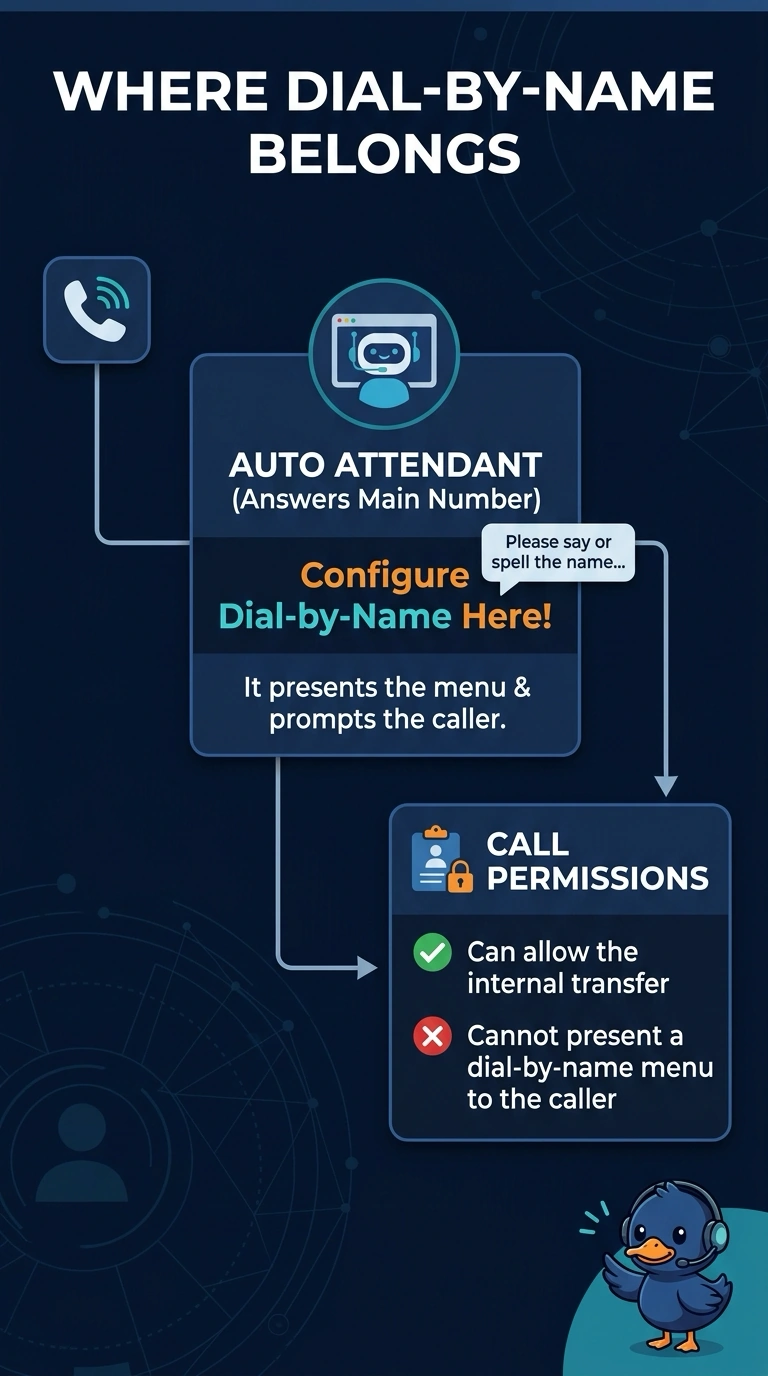
Dial-by-name is the lobby directory you spell on the keypad, not a stamp that says internal calls are allowed. Configure it on the auto attendant that answers the main number. A call permission can let the transfer through and still have no way to spell a name.
Full Explanation
An auto attendant can offer dial-by-name so a caller spells a person and is transferred. The hotel wants that behavior on the main number, and internal call permissions already allow the transfers, so dial-by-name belongs on the auto attendant that answers the main number. A call permission can allow the internal transfer and still cannot present the menu. Putting it on the internal call permission confuses allow-or-block with a directory. Allowing that call type does not build a name menu and does not match letters a caller spells. Putting it on a translation pattern for the main number only rewrites digits. Rewriting spelled digits into an extension is not a name directory, and a translation does not prompt the caller to spell a name. Putting it on the local gateway trunk asks the trunk to play a prompt. The trunk connects calls toward a route group. It does not present dial-by-name before route selection. Exam caveat: dial-by-name, business hours, after hours, and holidays are attendant behaviors, not call permissions. Operational check: call the main number, choose name spelling, enter a test staff name, and confirm the transfer lands on that person.