
After the hospital path to Webex has recovered, phones stay on the Survivability Gateway because an engineer left a temporary endpoint override forcing local registration to the gateway in place. What should steady state look like?
Select an answer to reveal the explanation.
Short Explanation
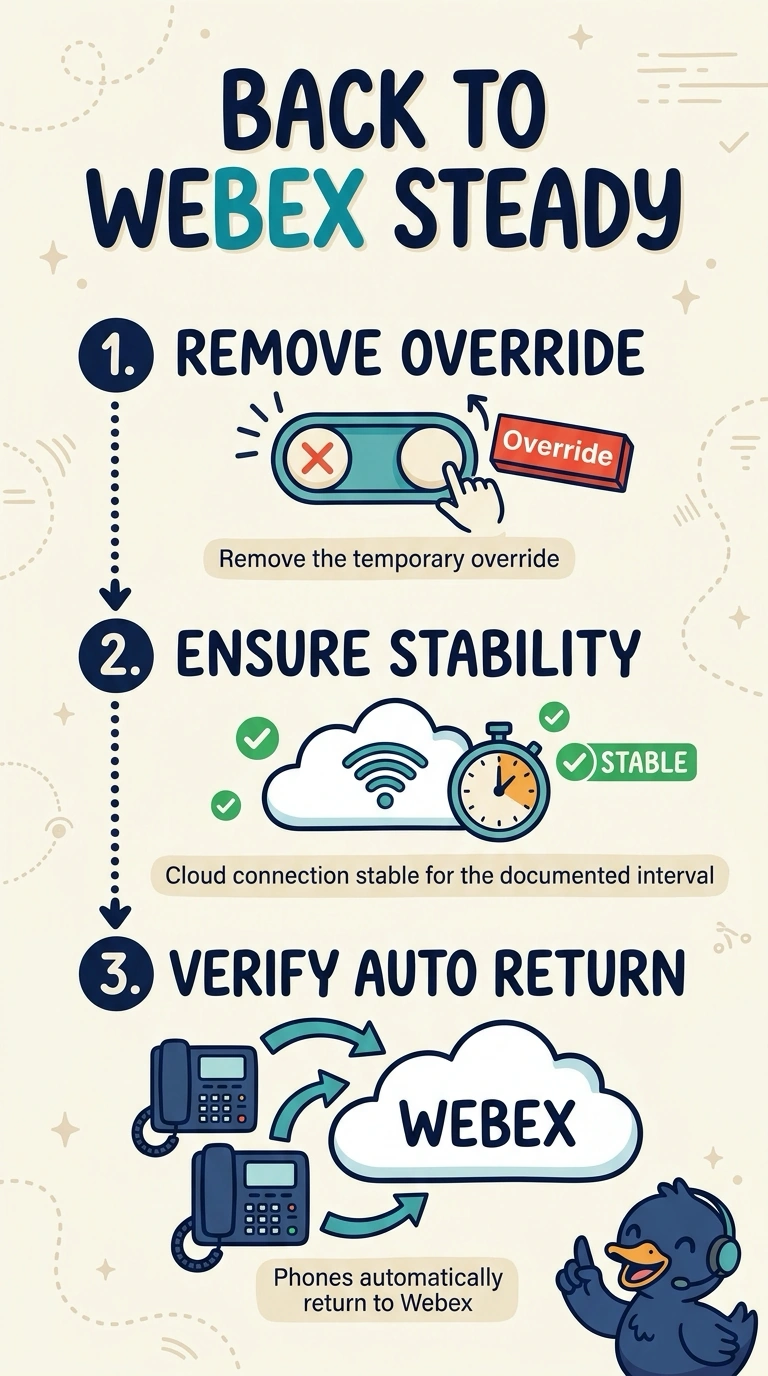
Once the main bridge is open again, you stop sending everyone across on the foot ferry. You remove the temporary override and verify your phones return to Webex after the connection has been stable for the documented interval. Don't leave the gateway as your steady home.
Full Explanation
Phones normally register to Webex. The Survivability Gateway is the local fallback when that path fails, and it provides basic backup calling. After the hospital path to Webex has recovered, a temporary endpoint override that pins phones to the gateway is no longer the steady state. Remove the temporary override and verify the phones automatically return to Webex after the cloud connection has been stable for the documented interval. Leave those forced Survivability Gateway registrations in place and keep the fallback registrar as the normal steady state after recovery freezes the outage mode. Point the phones at the identity provider so that single sign-on is what rebuilds dial tone on the gateway confuses authentication with call registration. The identity provider authenticates users. It is not the registrar that gives the phones dial tone, and sign-on does not replace the return to Webex. Add another registration on the same digest username in the hope of increasing fallback calling capacity mixes in the registration-based local gateway. Extra capacity there means another trunk in a route group, not a second registration on the same digest username, and capacity is not why these phones are stuck after recovery. Exam caveat: the fallback registrar is not steady state once Webex is back. Operational check: remove the override and confirm the phones register to Webex.