
During a cloud outage, warehouse phones are registered to the Survivability Gateway. A supervisor still expects cloud voicemail menus and one-tap meeting join. What does this mode provide?
Select an answer to reveal the explanation.
Short Explanation
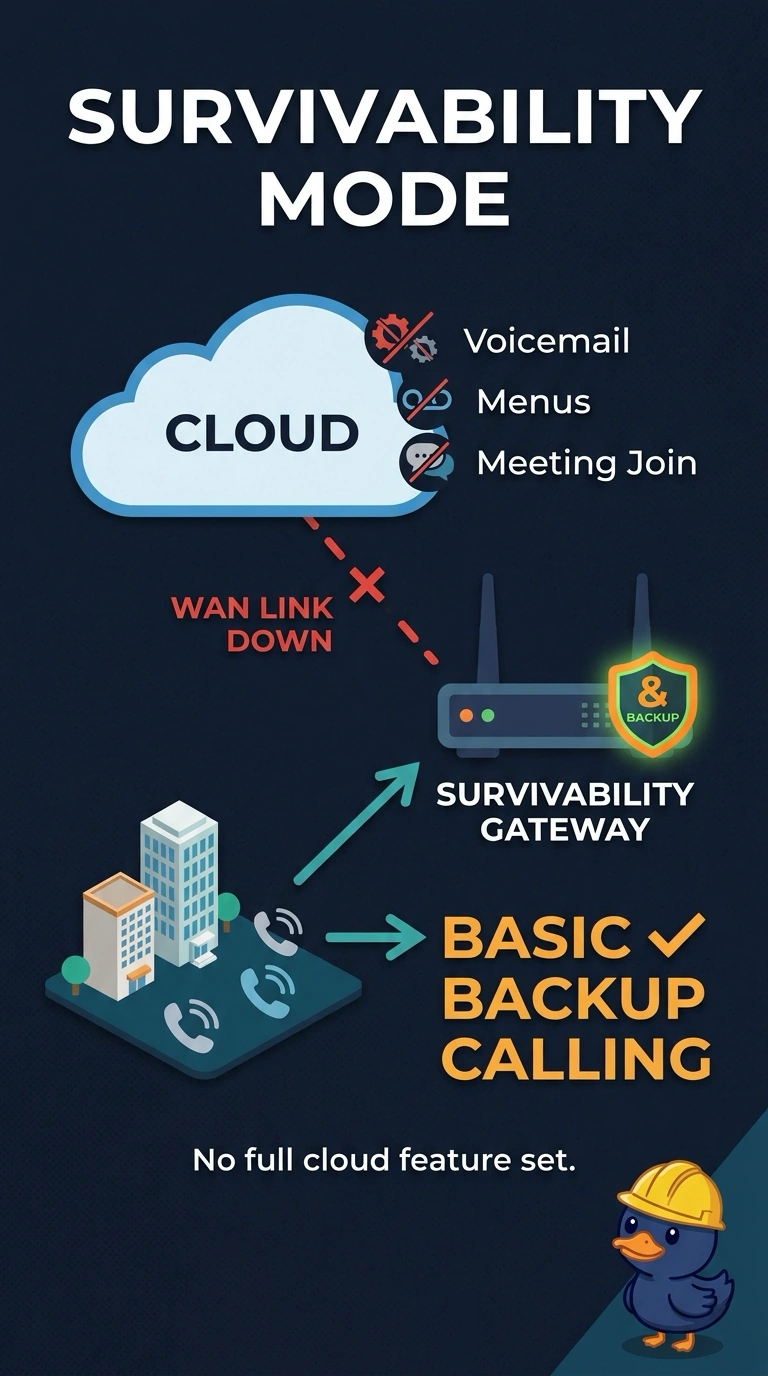
A spare flashlight is not the whole power grid you lost in a storm. Survivability gives you basic backup calling while the cloud is gone, not cloud voicemail menus and meeting join. Expecting the full feature set from that gateway is the trap.
Full Explanation
Site survivability gives phones a local registrar and basic backup calling when Webex cannot be reached. Cloud voicemail menus and meeting join belong to the full cloud feature set and are not served by that fallback. Basic backup calling, because survivability is not the full cloud feature set and cloud voicemail menus plus meeting join stay with the cloud. The full cloud voicemail menus and meeting join, because the gateway caches every cloud feature and serves them locally for the whole outage. The gateway does not cache that full cloud feature set. Directory synchronization only, because survivability keeps identities updating and does not place backup calls at all. Survivability does place basic backup calls. It is not limited to directory synchronization, and the sync is how internal routing was copied earlier. A replacement meetings site hosted on the gateway, because backup mode moves the meeting service on-premises and leaves ordinary calling in the cloud. Backup mode does not host a meetings site on the gateway. Calling is the local backup, and meetings stay a cloud service. Exam caveat: Outside calls during the outage still need a PSTN trunk on that gateway, and internal routing still depends on the sync taken while the cloud was up. Operational check: During a controlled outage, confirm a warehouse phone can place a basic internal call through the Survivability Gateway and that cloud meeting join is absent until Webex returns.