
A utility control building has a Survivability Gateway, and the substation office has none. When the WAN fails, substation phones still try to reach the control building across that failed WAN. What does the substation need?
Select an answer to reveal the explanation.
Short Explanation
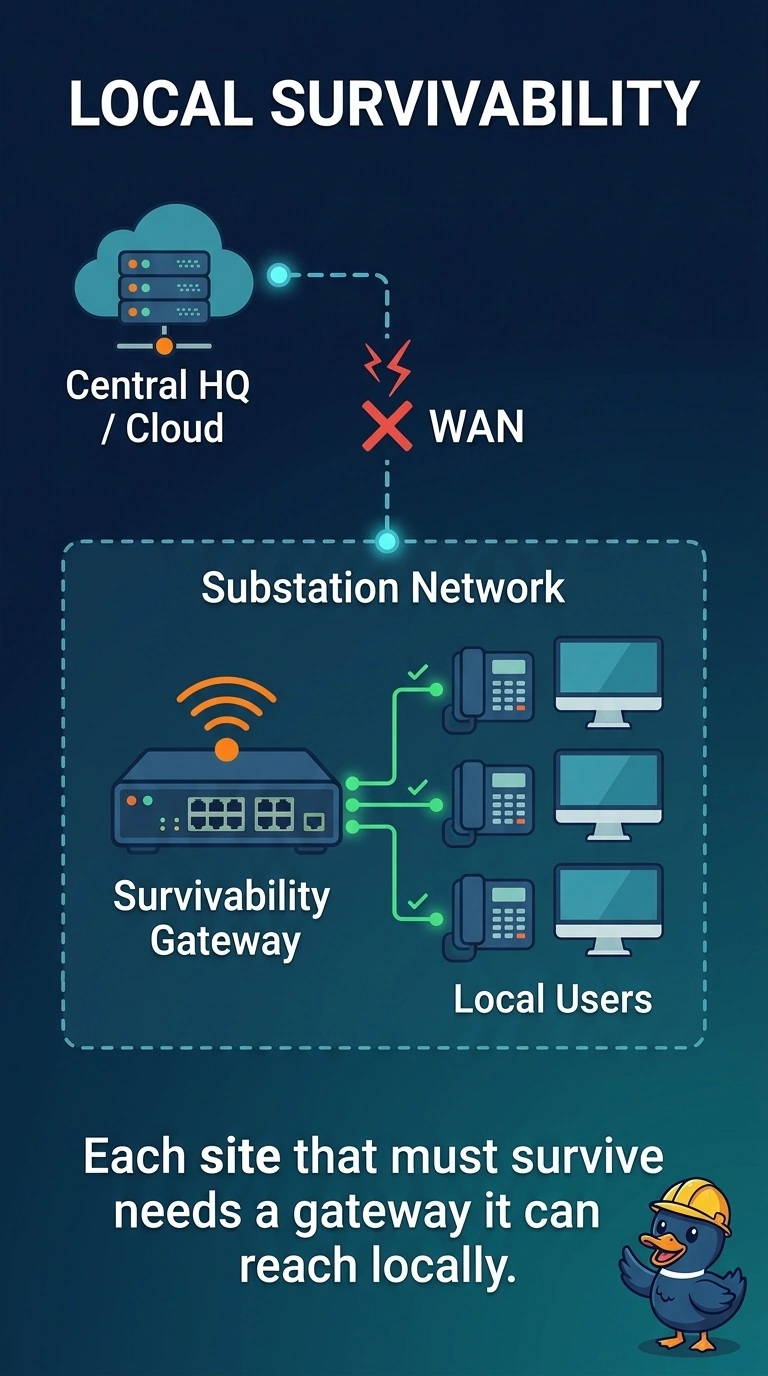
When the WAN is down, the substation cannot reach the control building’s gateway, just as you cannot use a fire extinguisher in the next building when the hallway is closed. You need a Survivability Gateway on the substation’s local network so its phones can use backup call control. A public DNS name or an auto attendant at the control building cannot make its gateway locally reachable.
Full Explanation
Each site that must maintain calling during a WAN failure needs a Survivability Gateway reachable on that site's local network. Because the substation phones cannot reach the control building gateway while the WAN is down, the substation needs its own gateway. A public DNS record for the control building gateway does not create a path across the failed WAN; a public DNS name can matter for a certificate-based local gateway, but it cannot make another site's gateway reachable. Increasing the concurrent-call registration on the control building trunk changes capacity, not the gateway's reach or the WAN path. More trunk capacity belongs in a route group and does not provide coverage for a site without a gateway. An auto attendant at the control building supplies a menu greeting; it neither registers remote phones nor provides backup call control. Exam caveat: Colocation on one Cisco IOS managed gateway still must be at the site that needs to survive. Practical check: Shut the WAN and verify that substation phones register to their local Survivability Gateway and can place an internal call without reaching the control building.