
A warehouse identity provider rotates its signing certificate, and single sign-on assertions then fail for every shift lead. Which update restores sign-in?
Select an answer to reveal the explanation.
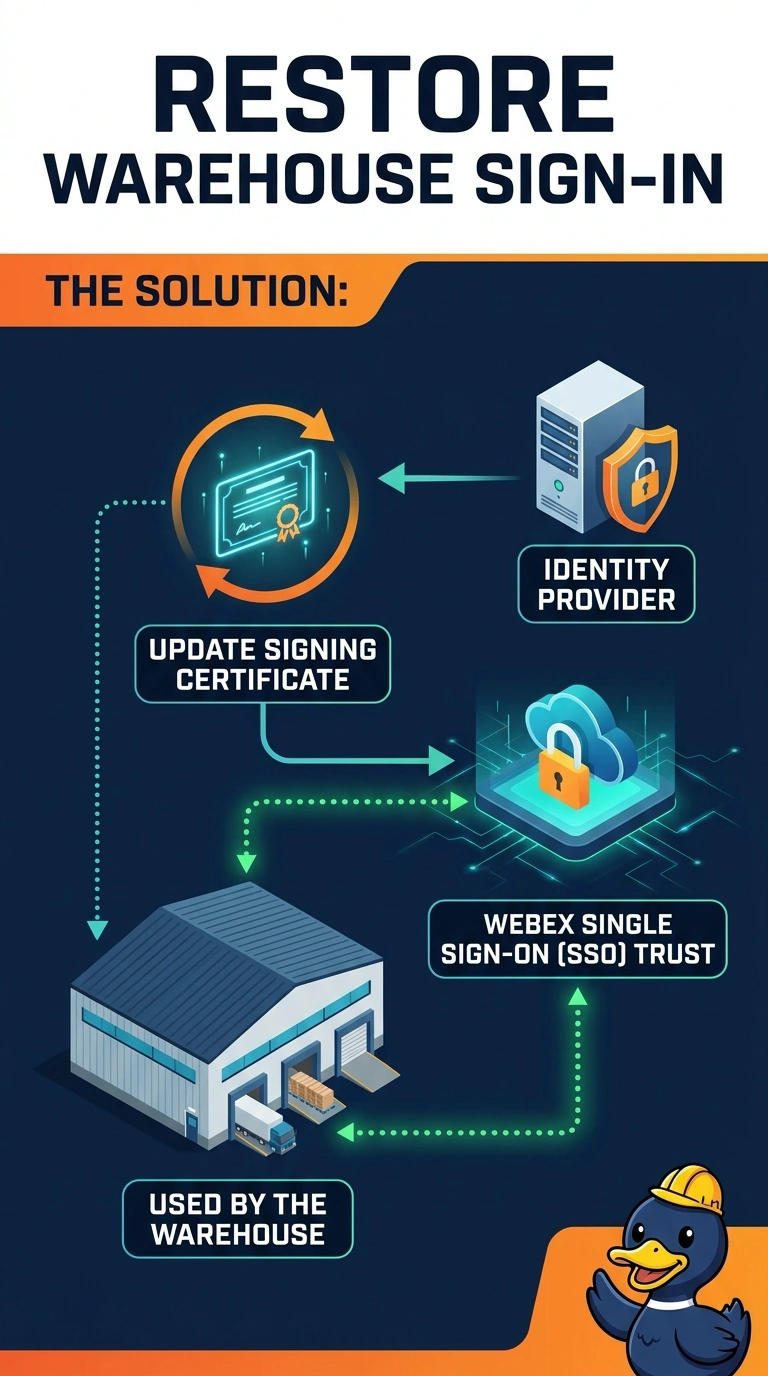
Short Explanation
A new wax stamp means nothing if the receiving office still has last year's sample on file. You update the identity provider signing certificate on the Webex single sign-on trust after that certificate rotates. The trap is resyncing the directory and hoping user records will repair a broken signature.
Full Explanation
A signing certificate that no longer matches the trust means single sign-on is not actually in a working path, even if it used to be. After the warehouse identity provider rotates that certificate, assertions fail until the trust is updated. You update the identity provider signing certificate on the Webex single sign-on trust used by the warehouse. Running a directory full sync so Active Directory rewrites every warehouse user into Control Hub and replaces the signing certificate syncs accounts and does not install the new signing certificate on the single sign-on trust. Moving the warehouse calling location to a different local gateway trunk and asking the shift leads to sign in again changes call routing and leaves the failed assertions in place. Toggling hybrid calendar off and on so the mailbox connection refreshes the failed single sign-on assertions refreshes a mailbox link, and hybrid calendar does not validate identity-provider signatures. On the exam, assertion failures right after a signing-certificate rotation are fixed on the single sign-on trust, not in the directory sync. In operations, place the new signing certificate on the trust and complete one shift-lead sign-in that reaches the identity provider.