
A hospital compliance office requires Webex message keys to be created in the hospital data center rather than by a Cisco-operated key service. Which design meets that requirement?
Select an answer to reveal the explanation.
Short Explanation
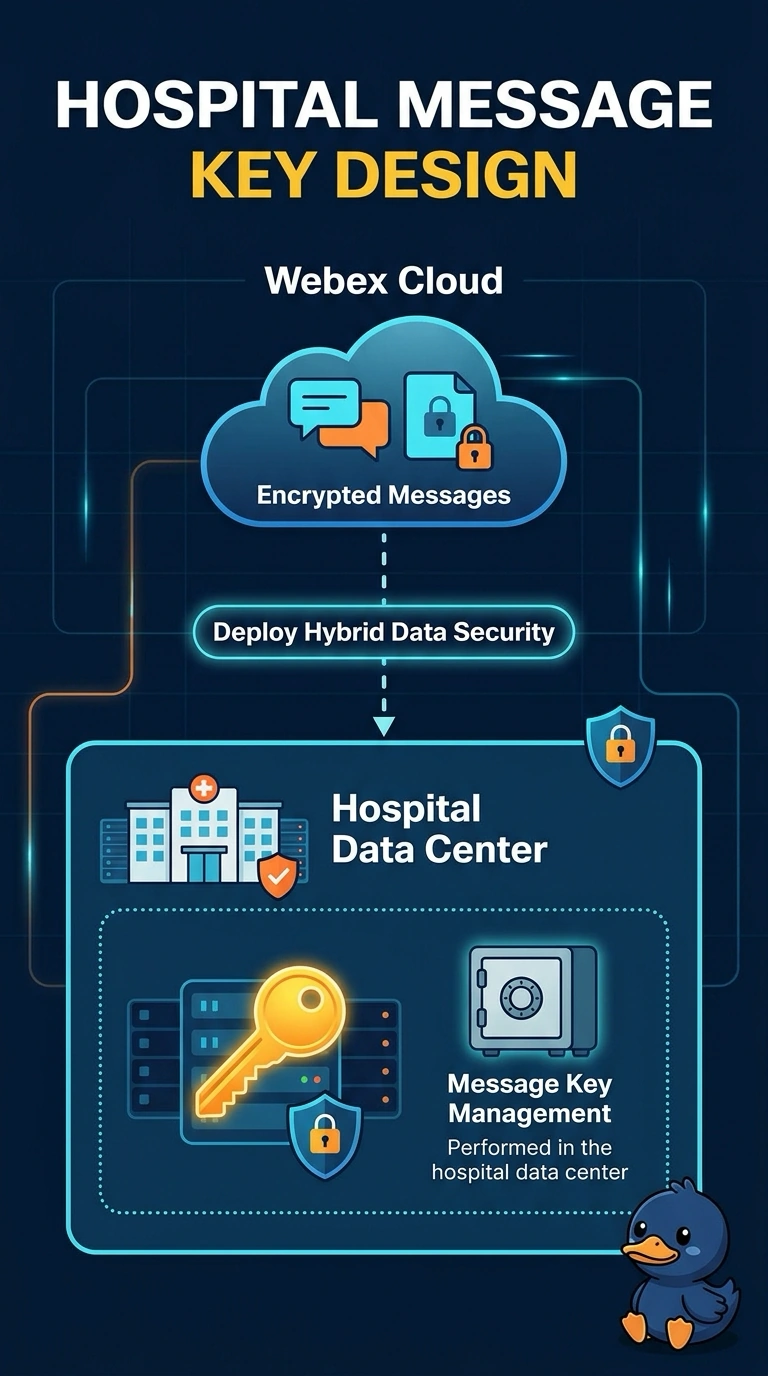
Picture a lockbox you insist on keeping in your own building instead of at the vendor shop. You meet the hospital requirement by deploying Hybrid Data Security so key management runs in that data center. The trap is a Cisco-operated key service that only adds your customer main key and still creates the keys in the cloud.
Full Explanation
Hybrid Data Security moves key management into the customer data center, along with indexing and compliance. That is the deployment that creates message keys on hospital premises instead of in a Cisco-operated service. Identity and the encrypted content store stay in the cloud, so the change is specifically about keys, indexing, and compliance. Deploy Hybrid Data Security so that message key management is performed in the hospital data center is the design that matches the requirement. Deploy HDS for on-premises KMS; configuring a CMK controls the main key used to protect content keys. Leave key creation on the Cisco-operated cloud key service and protect those keys with a hospital-owned customer main key describes bring-your-own-key. That model keeps the Cisco-operated key service and only adds a customer main key, so the keys are still created in the cloud. Move only the identity service into the hospital data center and leave message key creation in the Cisco cloud changes where users authenticate and does not move key creation. Store readable message bodies on a hospital file server and bypass the key management service entirely abandons encryption. The content server is meant to hold encrypted messages and files, not a readable local copy. Exam caveat: a hospital-owned customer main key does not turn the cloud key service into Hybrid Data Security. Operational check: confirm this organization uses the hospital Hybrid Data Security nodes for key management and is not left on the Cisco-operated key service with only a customer main key.