
A library security team wants the master key kept outside Cisco's cloud while Cisco continues to operate the key service. Which approach matches that requirement?
Select an answer to reveal the explanation.
Short Explanation
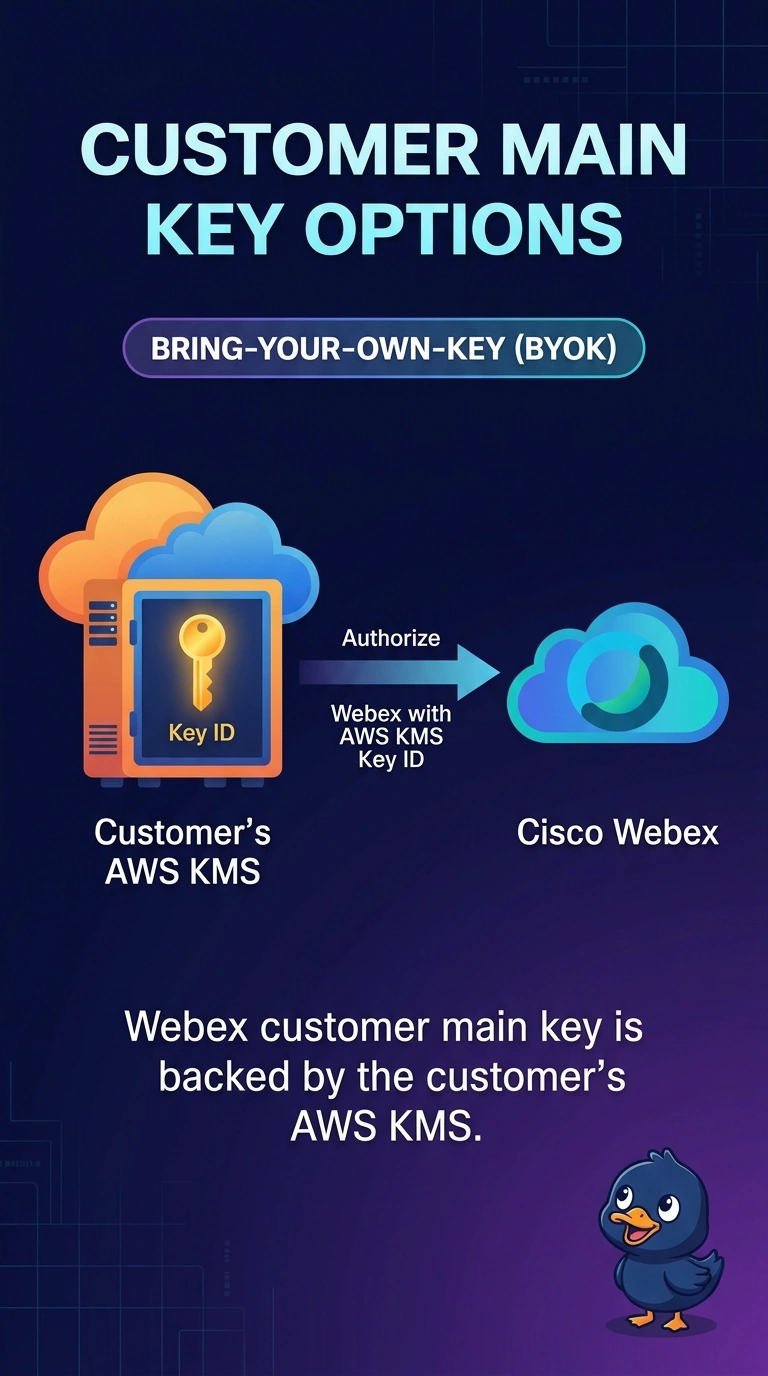
You can authorize Webex to use your customer AWS KMS key by its key ID while keeping the master key outside Cisco’s cloud. The key distinction is custody: Hybrid Data Security moves key management on-premises, while a verified domain and device PIN do not change where the master key is held or who runs the key service.
Full Explanation
The Webex customer main key backed by the customer’s AWS KMS meets the requirement: you authorize Webex to use the external master key by its AWS KMS key ID, so the key remains outside Cisco’s cloud while Cisco continues to operate the key service. Hybrid Data Security is not the match because it moves key management, indexing, and compliance on-premises; that changes the operating model rather than keeping the key service with Cisco. A verified organization domain proves ownership of mail names and supports domain and account management, but it does not affect master-key custody or key-service operation. An endpoint PIN on each desk device locks the local screen and controls device access, but it neither moves the master key nor changes who operates the key service. The exam caveat is to distinguish an externally held key used by Webex from moving key management and related functions on-premises: external key custody alone does not mean the whole security service has moved. As a practical check, verify that Webex is authorized against the customer’s AWS KMS key ID and that key management remains with the customer’s AWS KMS rather than being moved into the library data center.