
A hotel group wants calls that cannot fit on a full local-gateway trunk at site A to overflow onto the trunk at site B. What has to state that overflow order?
Select an answer to reveal the explanation.
Short Explanation
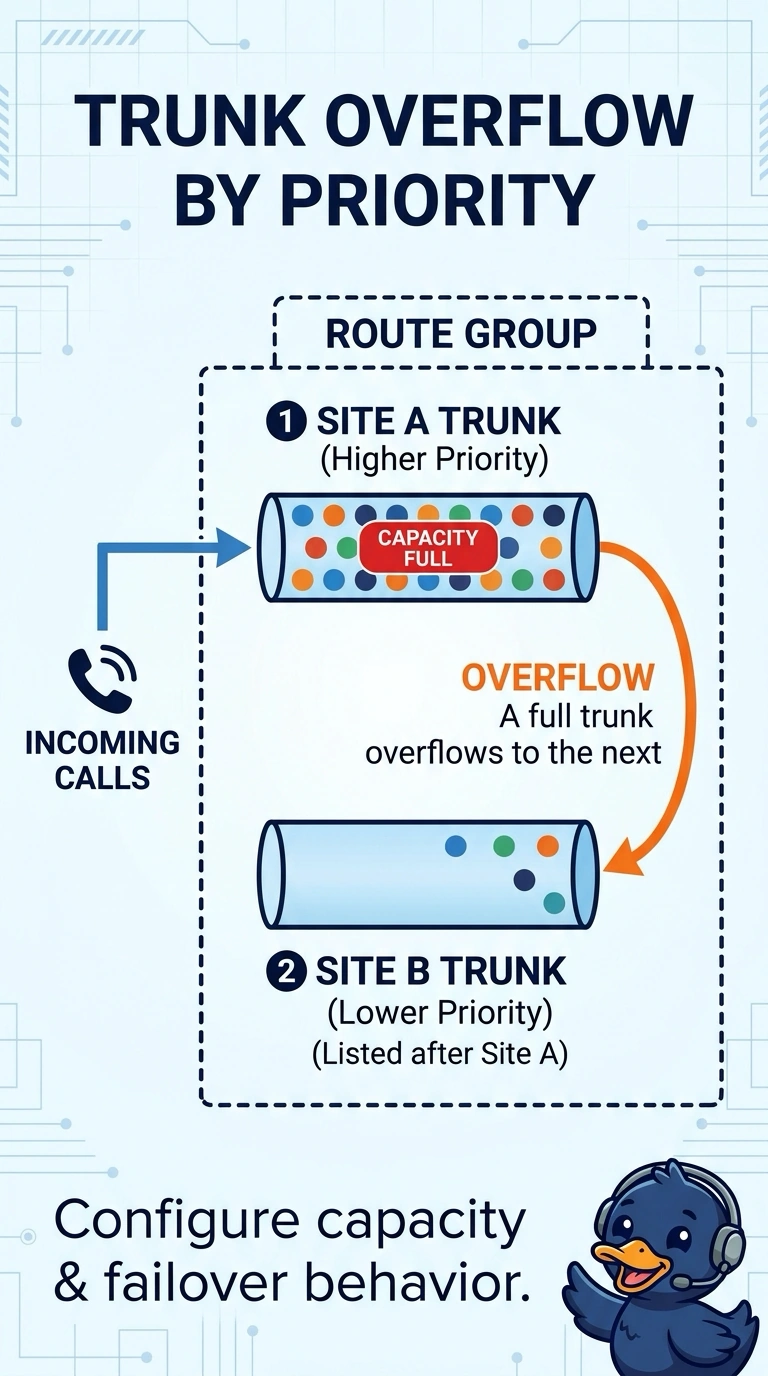
When the first checkout lane is full, the sign has to point you to the next lane. Site B's trunk has to follow site A's trunk in the route group so a full trunk overflows. The trap is adding a second auto attendant and expecting that menu to grow trunk capacity.
Full Explanation
A route group is an ordered set of trunks used for capacity and failover. Configure site A’s trunk at higher priority than site B’s trunk in the route group, and configure supported capacity and failover behavior, so calls that cannot fit on site A overflow to site B. Same-priority trunks distribute calls; the configured priority governs preference. A second auto attendant plays another menu for callers who find the trunk full, and another menu does not increase trunk capacity or overflow the call. Changing the executive international permission allows or blocks a call type, and a permission does not make a full trunk overflow by call type. A translation pattern rewrites digits, and rewriting site A calls into site B numbers when a menu key is pressed does not choose the next trunk. On exam day, overflow is the route group priority and failover, not a second auto attendant, an international permission, or a translation that fires when a menu key is pressed. After the change, place enough calls to fill site A’s trunk and confirm the next call uses site B’s trunk. Calls past one trunk’s capacity are rejected unless another trunk in the route group can take them.