
After a factory migration, copied Unified CM route patterns ignore the Webex location model, and outbound calls leave through the wrong gateway. How should those patterns be rebuilt?
Select an answer to reveal the explanation.
Short Explanation
Copying old highway signs into a new city sends drivers out the wrong exit. You rebuild those Unified CM route patterns as location dial plans and route groups so each site uses its own gateway. A copied pattern that ignores the location model keeps choosing the wrong door.
Full Explanation
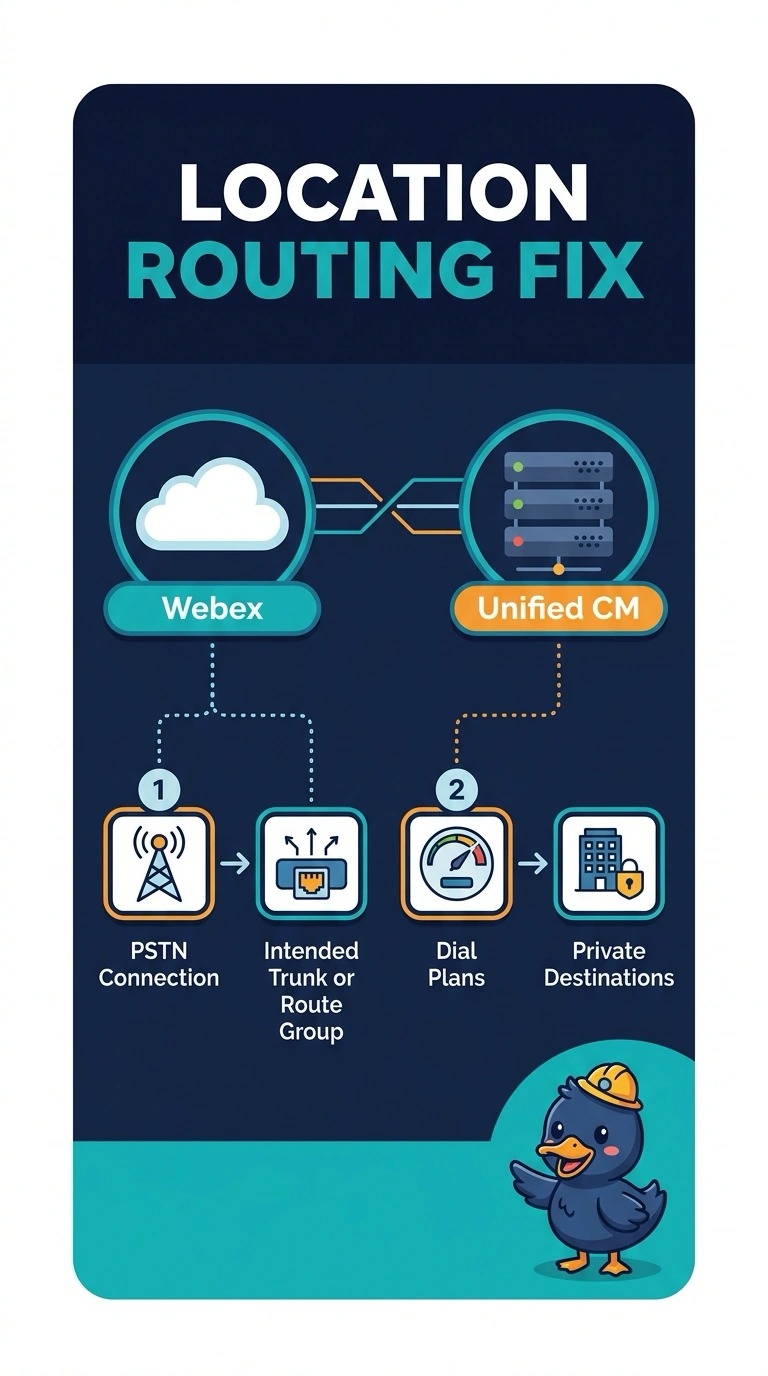
A Webex Calling location owns the site gateway, and a route group is the ordered set of trunks for that site. Copied Unified CM route patterns that ignore the location model send calls out the wrong gateway. Set each location’s PSTN connection to its intended trunk or route group and configure dial plans for private destinations. Dial plans define destination matches. Configure the PSTN connection for the calling location separately. One organization-wide call permission allows or blocks a call type. Allowing the call type does not choose which factory gateway a pattern will use. A Directory Connector full sync brings directory users into Control Hub. The connector does not rewrite old route patterns into Webex locations and route groups. One translation pattern copied unchanged from Unified CM only rewrites digits. Rewriting digits on a single pattern does not select the correct gateway for every factory site, and a translation does not replace location routing. Exam caveat: a user who moves sites must not keep the old site's trunks mixed with the new site's permissions. Rebuilding on locations avoids that mix. Operational check: place an outbound call from each factory site and confirm it leaves through that site's gateway and route group.