
A clinic user dials a short code that exists in two Webex Calling locations, and the call reaches the other site's service desk. Internal call permissions already allow the call. What must the dial plan force so the short code stays with the caller's site?
Select an answer to reveal the explanation.
Short Explanation
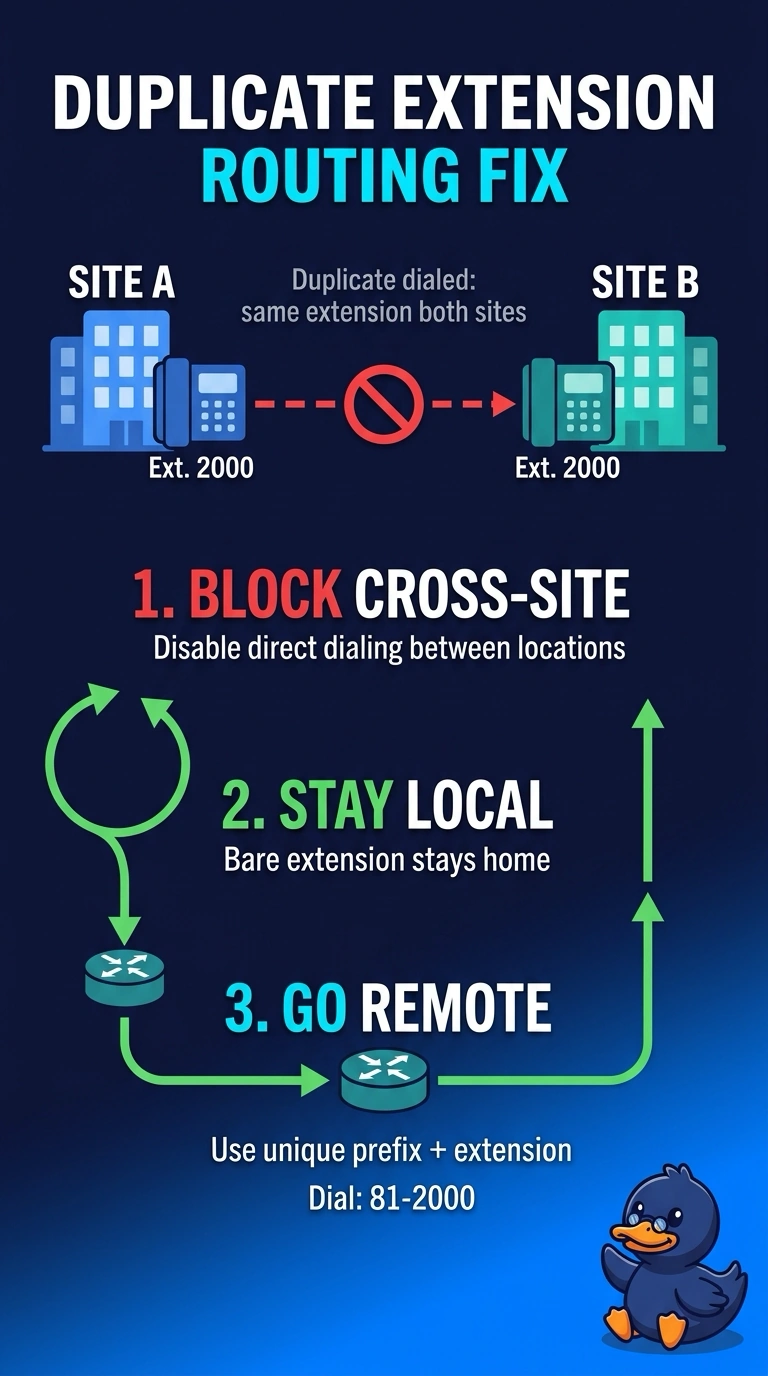
Think of two sites sharing the same extension as two houses with the same apartment number — you need a building prefix to leave home. You disable extension dialing between locations so your bare extension stays local, and you add a unique location routing prefix plus extension only when you really want the other site.
Full Explanation
When the same extension exists in two Webex Calling locations, leaving inter-location extension dialing enabled creates an ambiguous match that can send the call to the other site's service desk. The correct fix is to disable extension dialing between locations for duplicate extensions. Use the bare extension locally and a unique location routing prefix plus extension for cross-location dialing. That keeps intra-site calls anchored to the caller's own location while still providing a deterministic way to reach the other site when the prefix is dialed. Internal call permissions already allowing the call confirms the issue is not authorization but routing selection. A stricter international permission only allows or blocks an external call type. It cannot resolve which location owns a duplicate internal extension, and using it to block duplicates would break legitimate internal calling. A meeting lobby holds participants joining a meeting until admitted. It has no role in dial-plan digit analysis and cannot steer a dialed extension to the correct site. A directory resync refreshes user and directory records. It does not merge duplicate extensions, create routing prefixes, or replace dial-plan control, so directory data alone cannot keep the digits local.