
A hospital Directory Connector runs on a server that cannot reach Active Directory, so each sync returns no directory data. Which repair lets the connector read the directory?
Select an answer to reveal the explanation.
Short Explanation
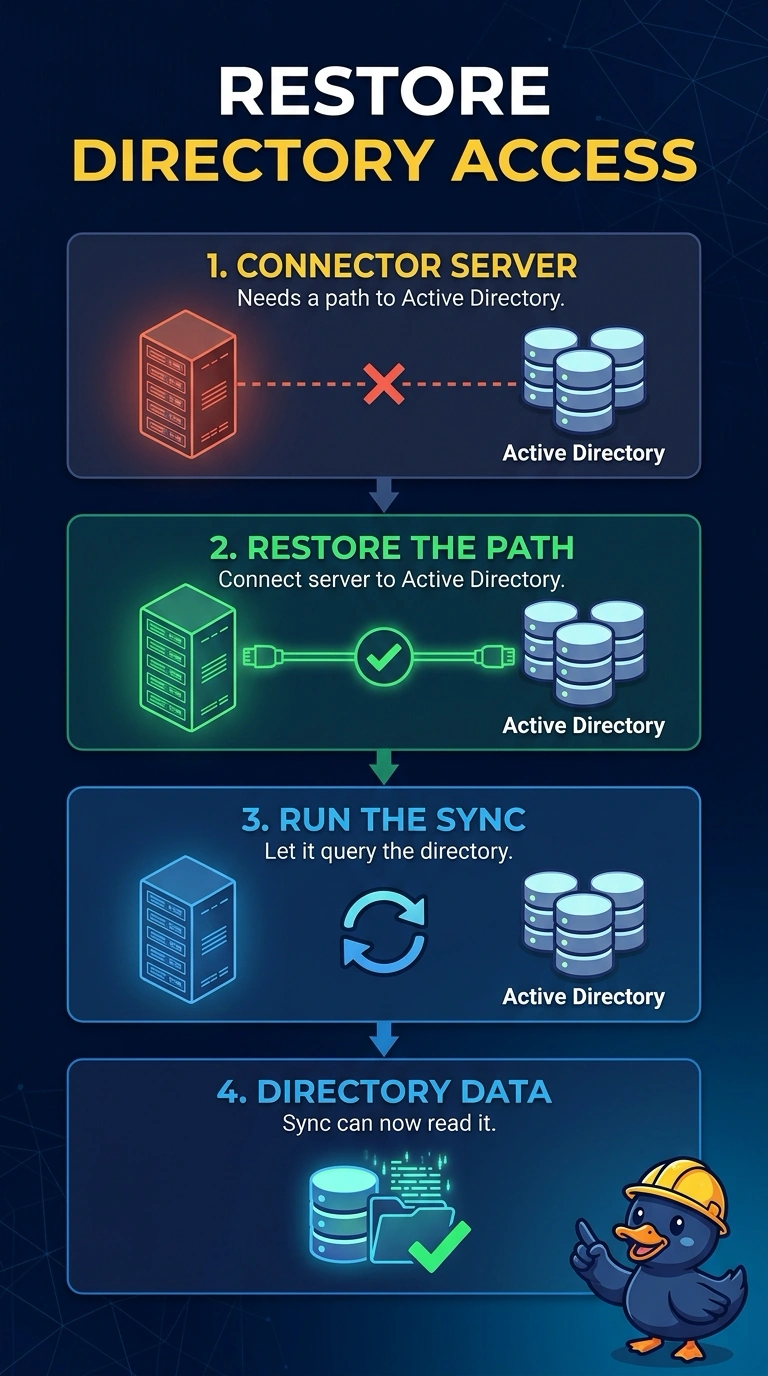
A librarian who cannot reach the stacks will hand you an empty cart no matter how valid the library card is. You restore the path from the connector server to Active Directory so the sync can query that directory. Single sign-on metadata authenticates users, and it does not query the directory for the connector.
Full Explanation
Directory Connector has to reach Active Directory to sync, and a server that cannot reach the directory returns nothing useful. Restore the path from the connector server to Active Directory so the sync can query that directory, which is the repair for this hospital connector. Replace the single sign-on metadata, which sends users to the identity provider and does not query Active Directory for the connector, and you change authentication redirection rather than the connector network path. Rotate a SCIM token, which does not repair an on-premises Directory Connector that cannot reach Active Directory, and you refresh a cloud provisioning secret for a different sync model. Add the hospital users by hand in Control Hub while the connector still owns that synced population and you create accounts beside the source of truth, which a connector-owned organization does not do for that population. Exam caveat: a SCIM token rotation does not repair an on-premises connector, and single sign-on metadata is not a directory query. Operational check: restore reachability from the connector server to Active Directory, run a sync, and confirm hospital users and attributes arrive in Control Hub.