
A warehouse runs two Directory Connector instances against the same Active Directory domain, and the two synchronizations conflict. How should those connectors be arranged?
Select an answer to reveal the explanation.
Short Explanation
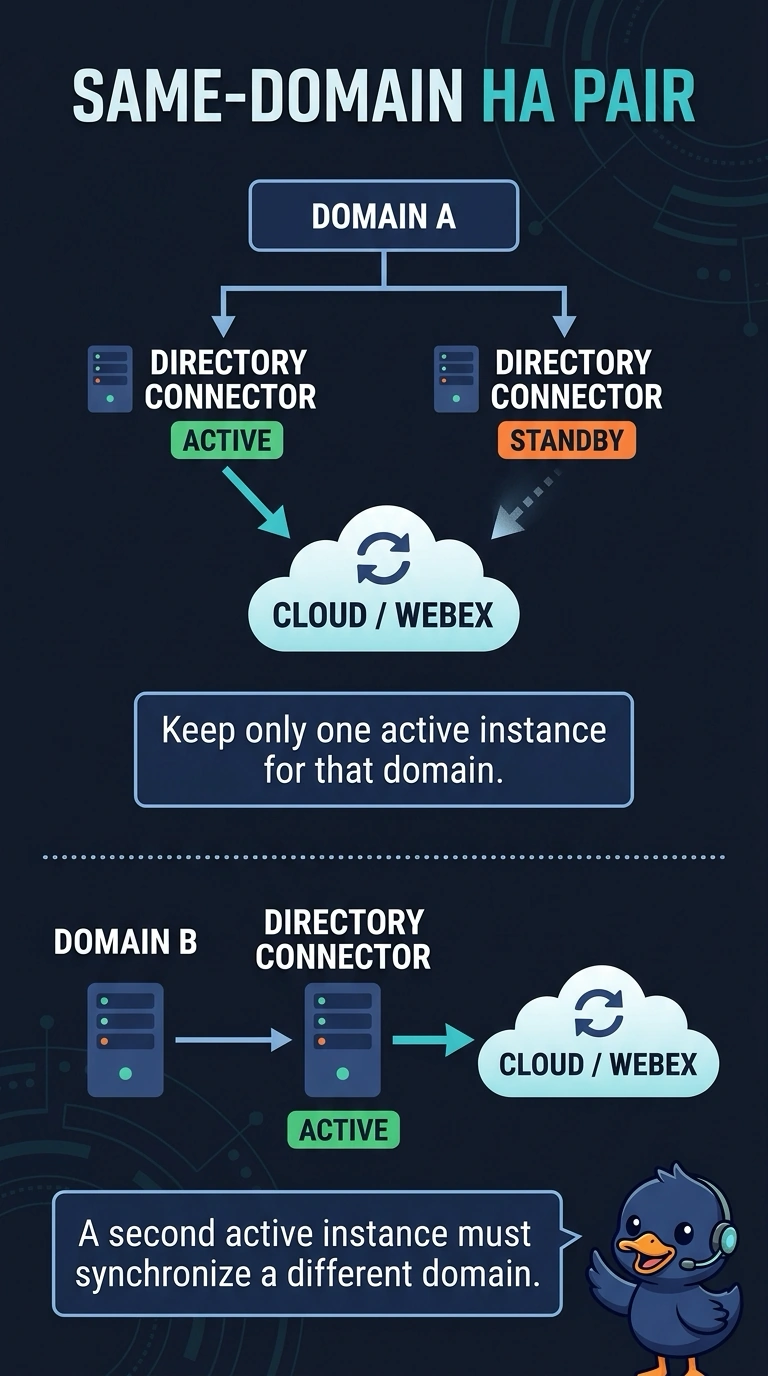
You’ve got two connectors competing to update one domain, so you need high availability, not two active synchronizations. Use Cisco’s documented setup with one active connector and one standby. That gives you one driver at a time, with a backup ready to take over.
Full Explanation
When two Directory Connector instances actively synchronize the same Active Directory domain without high-availability coordination, their updates can conflict. Use Cisco’s documented same-domain high-availability deployment, with one active synchronization and one standby. This arrangement allows only one connector to write at a time while the other remains ready to take over. Pointing both instances at the same domain and expecting them to fail over or merge conflicting updates on their own does not work: uncoordinated writers do not negotiate failover or reconcile changes. Stopping both connectors and adding warehouse users manually in Control Hub while a connector service still owns the directory also fails; directory-owned identities must continue to come from synchronization, and manual edits can create drift. Rotating an Entra ID SCIM token does not repair the conflict because SCIM provisioning for cloud identity is separate from coordination between on-premises connector services, and the sources must not overlap for the same organization. Exam caveat: two connectors aimed at one domain are not automatically a high-availability pair; the documented arrangement requires one active synchronization and one standby. Practical check: test failover and confirm that only one instance synchronizes at a time.