
A university engineer writes a device macro that tries to create a Control Hub user and assign a license when a guest badges into a room. The macro can call the on-device xAPI. Why does user creation fail, and what should create the user?
Select an answer to reveal the explanation.
Short Explanation
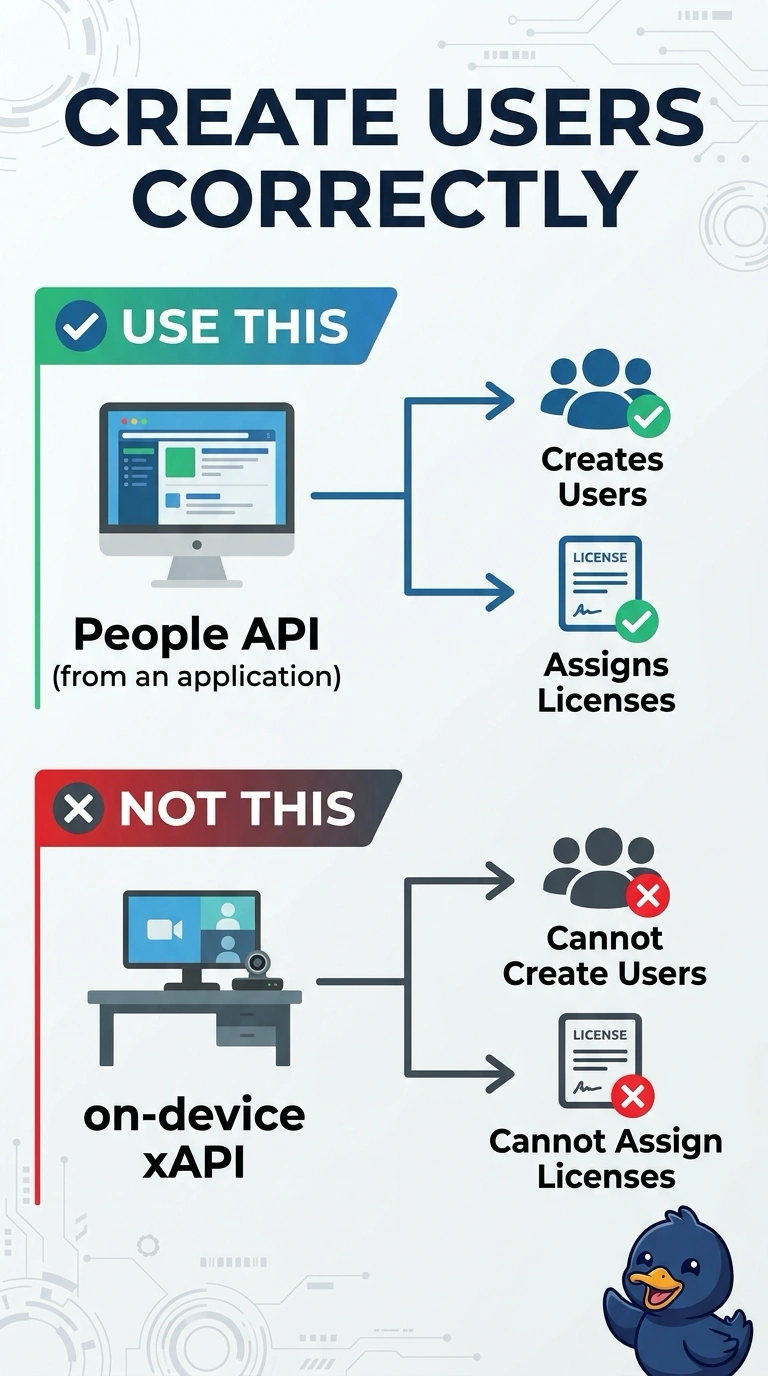
You can keep the room macro for device tasks, but create the university user and assign the license from an application with the People API. A calling translation pattern changes digits, macro distribution sends JavaScript to a device, and a cloud webhook is not what an on-device macro runs as.
Full Explanation
Device macros run on the room device and use the on-device xAPI for commands, status, events, and configuration. Creating a Control Hub user and assigning a license is user administration, so an application must use the People API; the xAPI cannot create organization users or assign their licenses. That is why the badge-triggered macro cannot create the guest. Converting the macro into a calling translation pattern would rewrite digits, not create a person or license a user. Relying on Control Hub macro distribution confuses sending JavaScript to a device with creating a user; distribution does not perform People API user administration. Running the same macro as a cloud webhook against the Meetings API also fails: that API and webhook approach do not make an on-device macro create a user when a guest badges in. Exam caveat: distinguish the People API’s user-administration role from device-level xAPI operations, and remember that a macro does not run in the cloud. Practical check: create a test user and assign the license from an application using the People API, then confirm the room macro no longer attempts user creation.