
Two clinics must encrypt patient-file replication across the public internet, and they do not need per-application steering. Which tunnel design matches that need?
Select an answer to reveal the explanation.
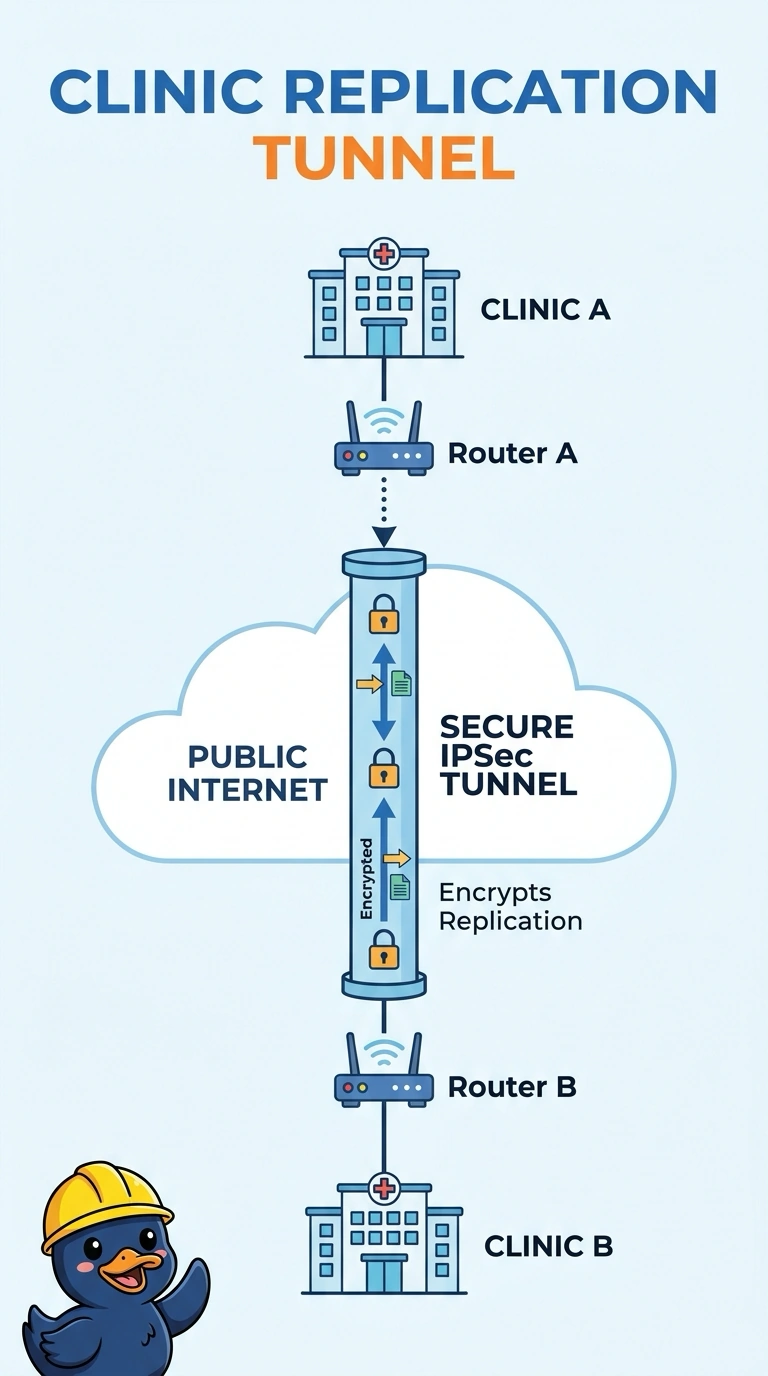
Short Explanation
Wrapping a letter without locking it still lets the carrier read the page. You encrypt the replication between the clinics with IPsec. GRE encapsulation, a provider label-switched path, or application steering does not encrypt that flow.
Full Explanation
The requirement is confidentiality on the public internet, with no request to steer one application differently from another. IPsec encrypts the replication between the clinic routers, while GRE can carry the same packets and does not encrypt them. A label-switched provider path is a way across the carrier network, not an encryption feature, and an application-steering overlay solves a different problem than the one stated. An IPsec tunnel that encrypts the replication between the two clinic routers is the design that meets this requirement. A GRE tunnel that encapsulates the replication and does not encrypt the patient files is the wrong fit because GRE wraps packets for delivery and leaves the patient-file payload readable on the public internet. A provider label-switched path that is a transport and not encryption by itself is the wrong fit because a provider path can be private and still does not, by itself, encrypt what the clinics send. An application-steering overlay that chooses a path and was not the requirement here is the wrong fit because application steering picks a transport, and the clinics asked for encryption rather than steering. Exam caveat: IPsec encrypts the tunnel and does not replace access control on the file share, so a stolen clinic password can still copy files after the tunnel is up. Operational check: Capture a lab replication across the internet path and confirm the payload is encrypted in the IPsec tunnel, then confirm a GRE-only lab capture still shows readable test data.