
A meal-kit company must block pod-to-pod traffic that stays inside the cloud-native nodes it operates. Which firewall architecture fits?
Select an answer to reveal the explanation.
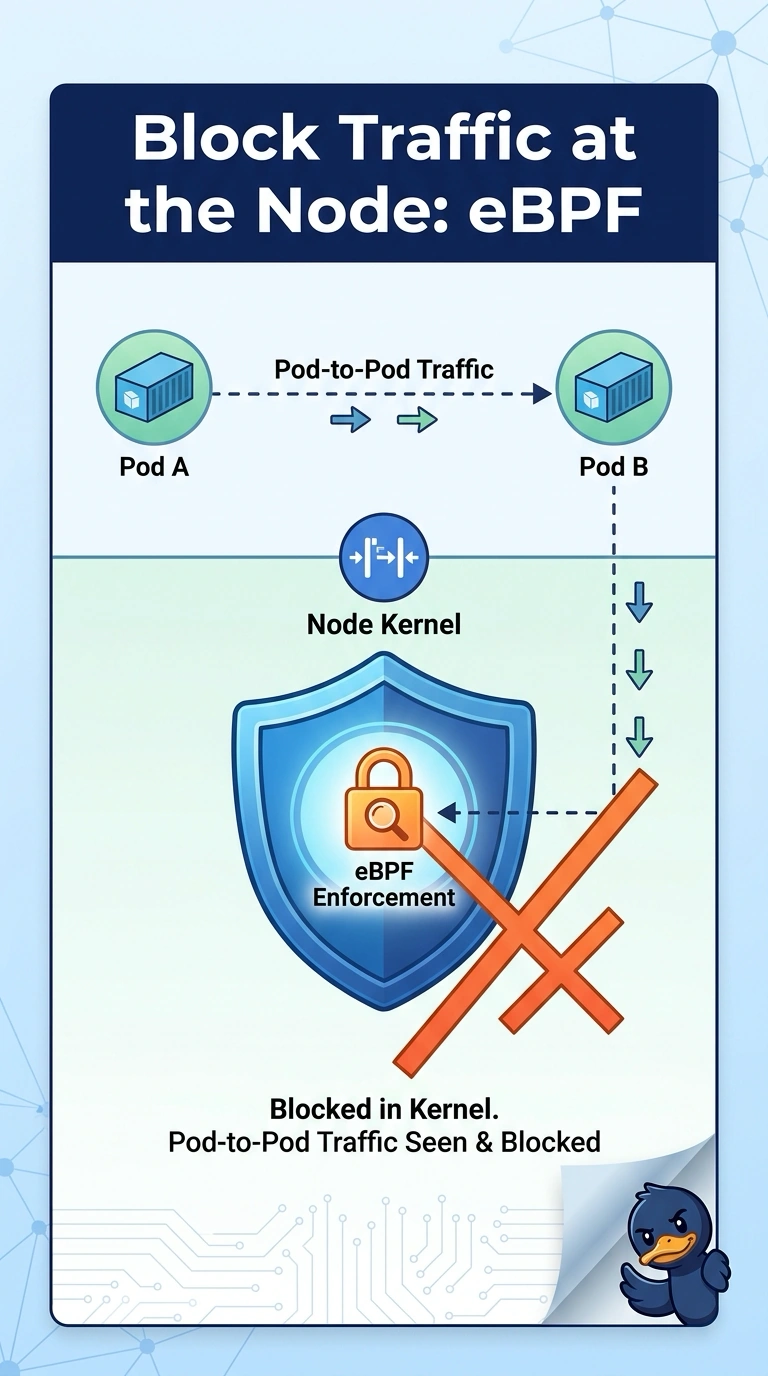
Short Explanation
Traffic between roommates stays in the house, so your front-gate guard cannot separate them. You enforce the pod rules with eBPF on the meal-kit node that actually sees those packets. A perimeter firewall, a web application firewall, or a detect-only sensor is aimed at the wrong place or the wrong action.
Full Explanation
The packets move between pods on the node and do not cross the office firewall. Enforcement has to sit where that traffic is visible, which is an eBPF control in the node kernel that can block it, and that block has to be inline on the node that forwards the pod packets. A perimeter firewall is on the wrong path, a web application firewall expects site HTTP, and a detect-only span cannot stop the flow. eBPF enforcement on the node, where that pod traffic can be seen and blocked in the node kernel is the design that meets this requirement. A traditional perimeter firewall that only sees sessions crossing the office boundary is the wrong fit because pod-to-pod traffic on the node does not cross the office perimeter, so that firewall does not see it. A web application firewall that inspects HTTP at the public site and not these pod calls is the wrong fit because a web application firewall is built for HTTP at a site and does not sit on this pod-to-pod path. A detect-only intrusion sensor on a span port that cannot block the pod traffic is the wrong fit because a span sensor can alert and is not inline, so it cannot block the traffic the team needs to stop. Exam caveat: eBPF on the node blocks what the node can see, and a separate public HTTP site can still need its own web application firewall in front of it. Operational check: In a lab node, generate a pod-to-pod flow the policy forbids and confirm the node drops it, then confirm an allowed pod pair still connects.