
A survey firm's encrypted field laptop was stolen, and the disk key is escrowed with the management service. The laptop is not back on any network. The escrowed key is the only usable copy and the laptop cannot unlock offline through a local protector. Which endpoint response fits?
Select an answer to reveal the explanation.
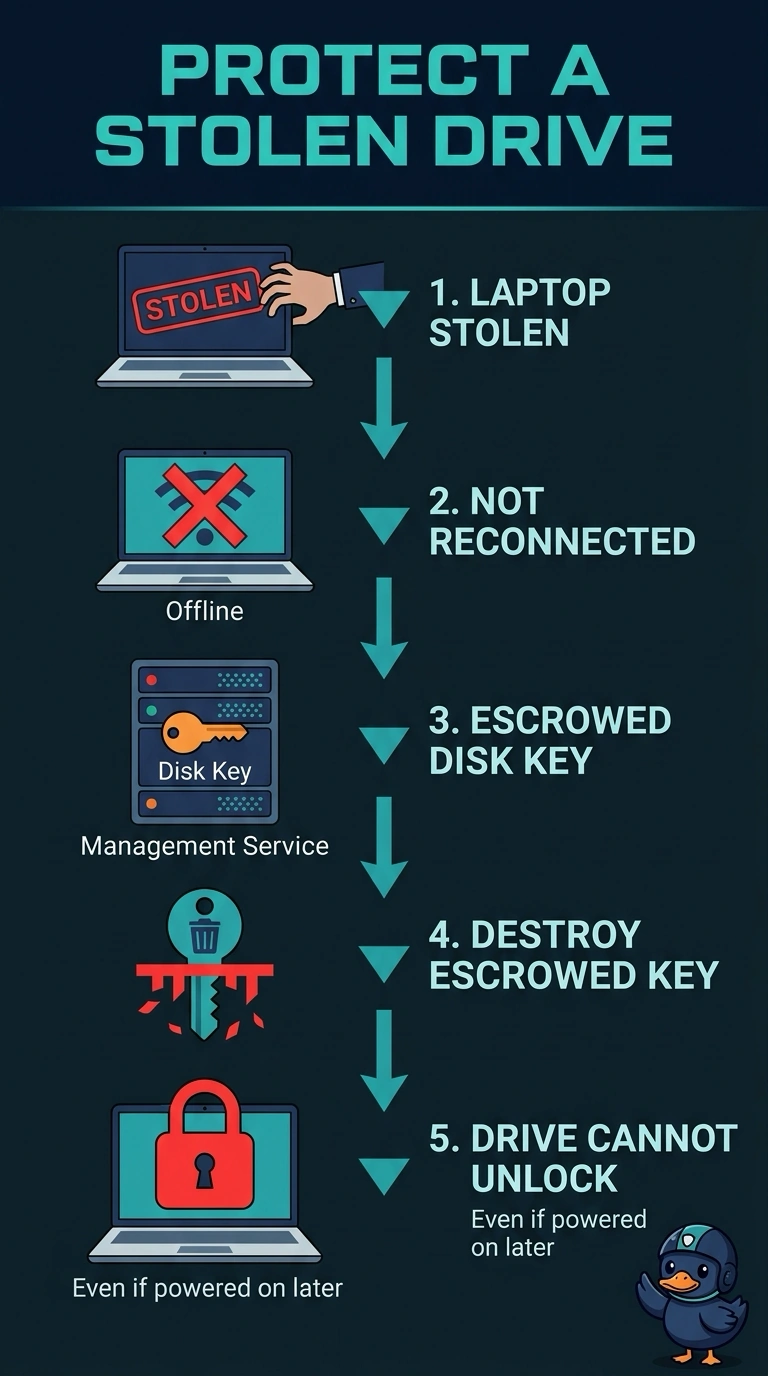
Short Explanation
You can protect the stolen laptop by destroying the only usable key, even while it is offline. Destroy the escrowed disk key so the encrypted drive cannot be unlocked later. Network isolation needs a live agent, a posture check waits for a future file-share request, and an admin-workstation rule does not affect this laptop’s key.
Full Explanation
The disk is already encrypted, and the only usable decryption key is the copy escrowed with the management service; there is no local protector that can unlock the laptop offline. Destroying the escrowed disk key is the crypto-erase: the stolen ciphertext no longer has a key the firm can release. Verify that all copies are sanitized, since deleting an escrow record alone would not remove any other usable key protector. A network isolation command sent to an endpoint agent on an offline laptop cannot take effect because it needs a live agent and network connection. A posture check that runs the next time the laptop asks for the survey file share only gates a future request; it does not destroy the key. A dedicated admin-workstation rule for office staff who manage the survey routers governs those office consoles and does not erase the key for this laptop. Destroy the escrowed disk key so the stolen drive cannot be unlocked if it powers on later; that directly meets the requirement. Exam caveat: If a second key copy is in a backup the thief can reach, destroying only the primary escrow copy leaves that other copy usable. Practical check: Revoke the escrow record for a lab serial and confirm that an unlock with the old disk key fails.