
A payroll clerk at a bakery chain badged into the Omaha plant, and minutes later the same account passed a password from another continent. No session should be created there. The identity risk engine receives the badge event and the network location is verified as the actual sign-in origin. Which control fits?
Select an answer to reveal the explanation.
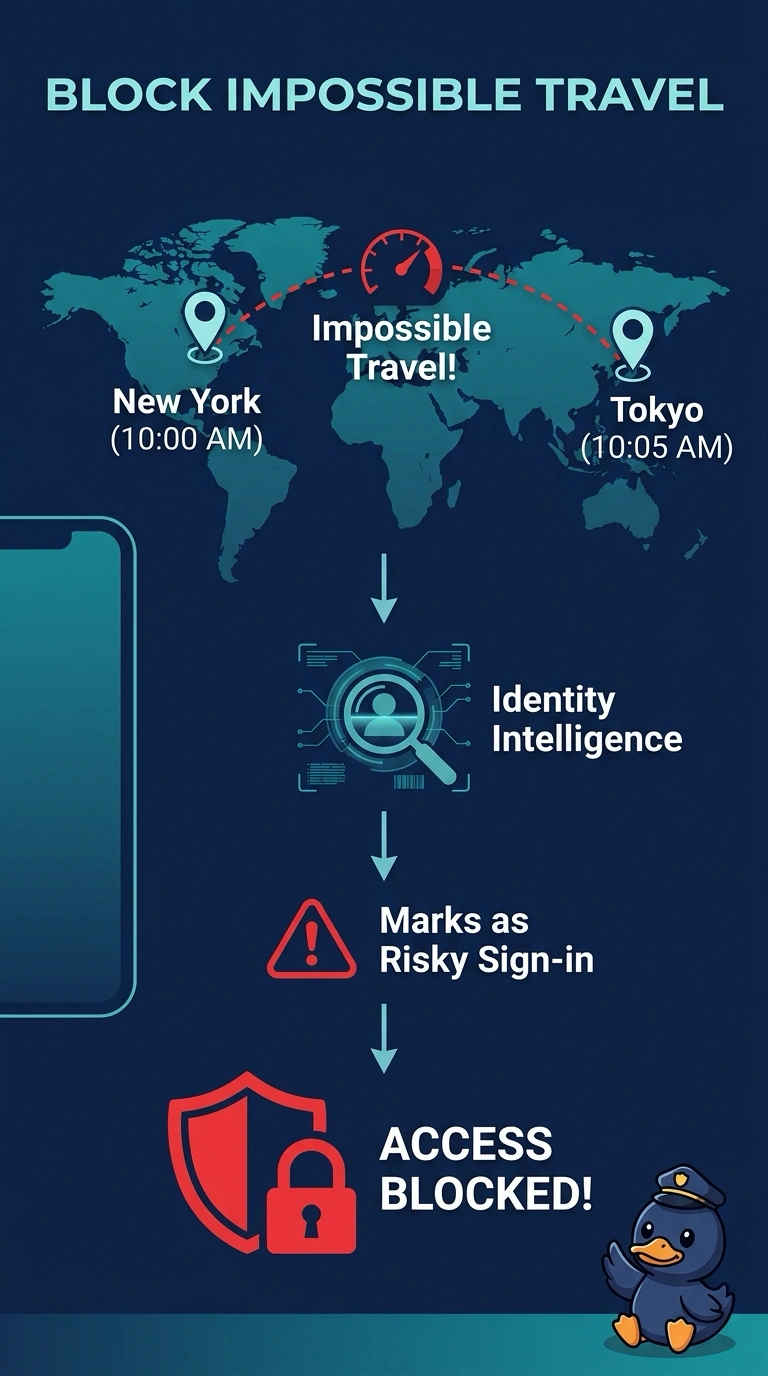
Short Explanation
A person cannot badge into Omaha and type a password overseas in the same few minutes. You block that sign-in with identity intelligence before a session exists. A longer password, a relayable text code, or extra personal questions can still be produced from the distant site.
Full Explanation
A badge swipe in Omaha and a password success on another continent cannot both be the clerk, so identity intelligence blocks the distant sign-in before a session exists. A configured access policy uses the resulting risk signal to block the attempt. A longer password, a relayable text code, and public personal questions are secrets someone far away can still produce. The control has to use that travel contradiction rather than ask for another phrase the distant site can type. Identity intelligence that marks the impossible travel as a risky sign-in and blocks it is the design that meets this requirement. A longer password on the same account the distant attempt is already able to present is the wrong fit because a longer password is still a typed secret, and the distant attempt can present it if it was already taken. A text-message code that a real-time relay can forward from the clerk's own phone is the wrong fit because a text-message code can be relayed while the clerk is in Omaha and does not contradict the travel. Extra personal questions whose answers can be gathered from public city records is the wrong fit because personal questions are public knowledge an outsider can collect, and they ignore the badge event. Exam caveat: Define an exception path for known trips where a clerk badges nowhere. Operational check: Confirm a distant sign-in is blocked before a session token is issued.