
A city payroll clerk signed in healthy this morning, and the laptop still passes its posture check. Starting the payroll run is the sensitive action. Which identity control fits that moment?
Select an answer to reveal the explanation.
Short Explanation
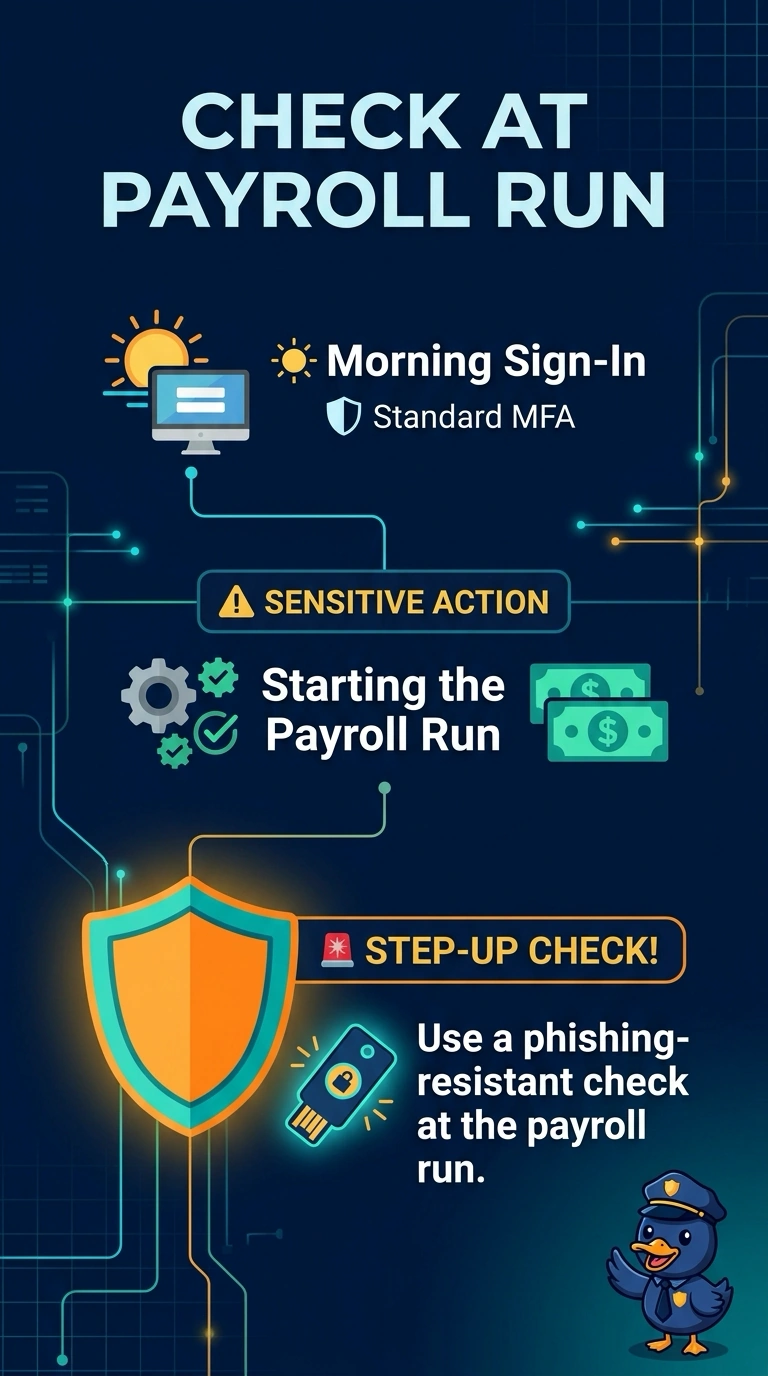
The badge that got you in the building is not the key to the vault. You step up to a phishing-resistant check when the payroll run starts. A longer idle timeout, a mail sandbox, or another healthy posture result does not guard that button.
Full Explanation
The morning sign-in and the healthy posture establish the session, not the payroll action. A step-up asks for a phishing-resistant check at the moment the run starts, so a leftover session cannot launch payroll by itself. Extending the idle timeout, sandboxing mail, and repeating a posture result that is already healthy never bind the person to that action. Step up to a phishing-resistant check at the payroll run, not only at the morning sign-in is the design that meets this requirement. A longer idle timeout on the morning session that already passed its posture check is the wrong fit because a longer idle timeout keeps the morning session alive and does not prove the person at the payroll button. A mail sandbox for attachments that plays no part in starting the payroll run is the wrong fit because a mail sandbox inspects attachments and sits off the path that actually starts the city payroll run. A repeated posture check that only confirms the same healthy laptop result is the wrong fit because posture on this laptop is already healthy, so repeating that same check does not prove who is starting the payroll run. Exam caveat: Step-up should cover the action that moves money, including a payroll run started from a script or a second app, not only the button in the first portal. Operational check: In a lab payroll app, start a run from a session that already passed posture and confirm the phishing-resistant prompt appears before the run is accepted.