
A publisher's connected mail app had consent to read every mailbox, and an attacker used that app. Passwords were reset and the same app consent is still in place. Which redesign follows?
Select an answer to reveal the explanation.
Short Explanation
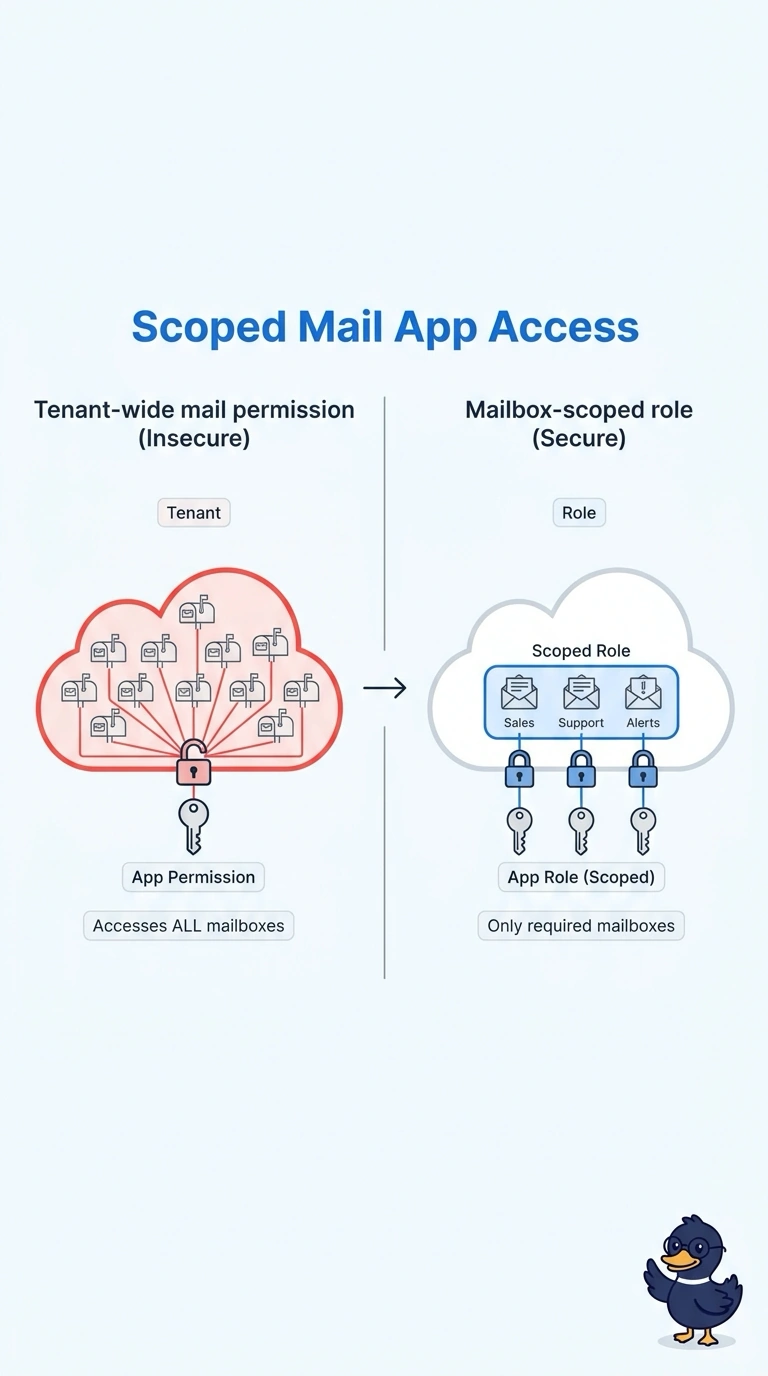
Changing the door code does not help if the spare key still fits every office. You shrink the app's consent to the mailboxes the job needs and you keep a way to revoke it. Another password reset, a restore onto the same consent, or lobby wireless leaves the wide grant in place.
Full Explanation
The incident used an application consent, not a password that a reset would retire. The redesign must remove the tenant-wide grant and limit the app with Exchange application RBAC. Remove the tenant-wide mail permission and assign the application a mailbox-scoped role for the required mailboxes. Another password reset, a restore onto the same consent, and a lobby network all still leave that tenant-wide mail grant in place for the next caller. Remove the tenant-wide mail permission and assign the application a mailbox-scoped role for the required mailboxes is the design that meets this requirement. Another password reset while the app keeps its tenant-wide mail consent is the wrong fit because a password reset does not shrink the application consent that still covers every mailbox in the tenant. A restored mailbox that still sits on the app consent the attacker used is the wrong fit because restoring mail onto the same tenant-wide consent puts the publisher back on the path the attacker used. A guest wireless network for a lobby that does not host the connected mail app is the wrong fit because lobby wireless was not the application consent that let the connected app read every mailbox. Check for any remaining broad grant that would bypass the scoped role and test revocation.