
Overnight a credit union sees failed logins for one teller, a new rule that hides messages in that mailbox, and a change to that teller's wire template. Each signal is already its own case. Which practice fits?
Select an answer to reveal the explanation.
Short Explanation
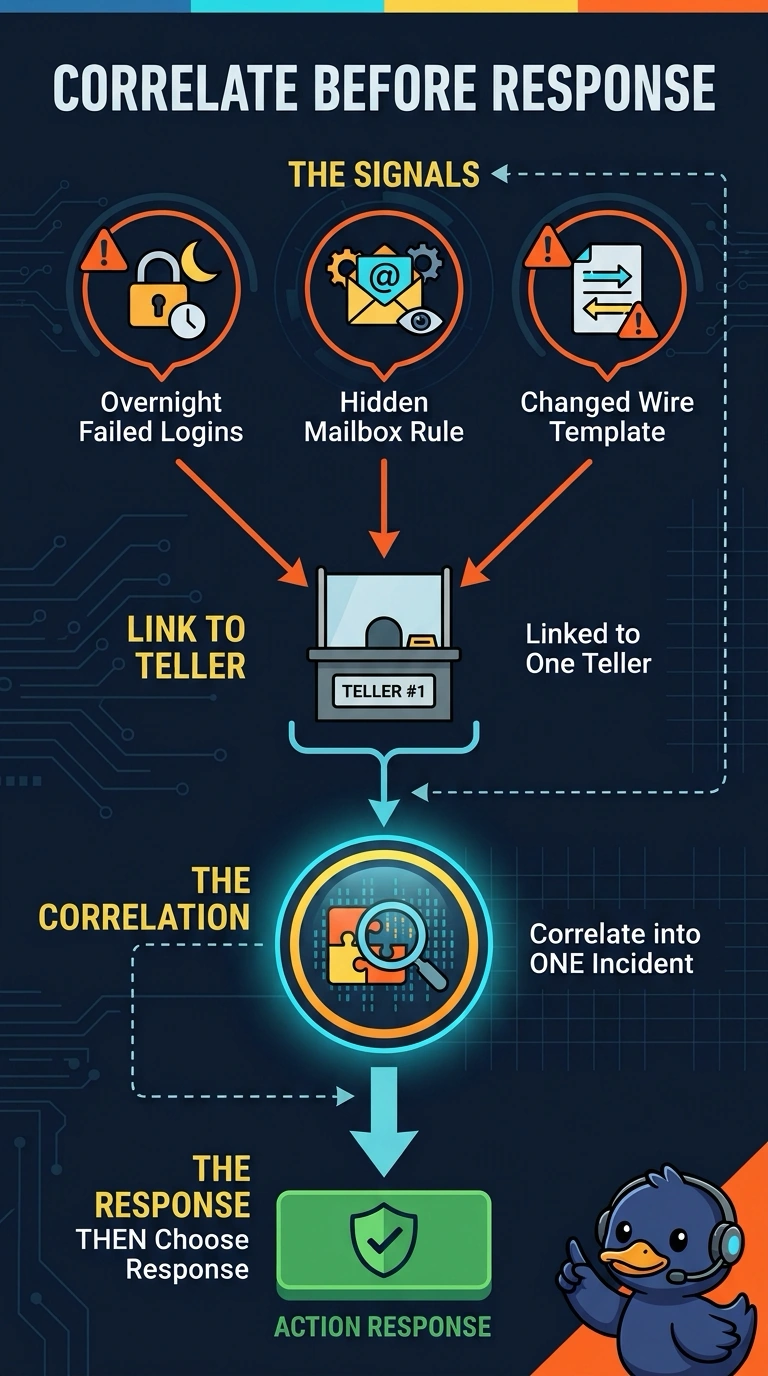
Three alarms can be one fire. You correlate the teller's login failures, hidden-mail rule, and wire-template change into one incident. Another dashboard tile, a lock on every teller, or enrichment that leaves the cases unlinked does not make that one fire.
Full Explanation
The three signals share one teller and describe a single story: access trouble, a mailbox hiding mail, and a payment template changing. Correlation pulls them into one incident so the response matches that story. A tile does not respond, a playbook that locks every teller skips the link and widens the blast, and enrichment without a join leaves three cases. Correlate the three signals on that teller into one incident before the response is chosen is the design that meets this requirement. A new dashboard tile that repeats the failed-login count beside the three open cases is the wrong fit because another tile redisplays a count the analysts can already see and does not join the three cases. A containment playbook that locks every teller before anyone links the three signals is the wrong fit because locking every teller acts on a wide population before the signals are shown to be one incident. Threat-intel enrichment that decorates each case and still leaves the three cases unlinked is the wrong fit because enrichment adds context to whatever case it touches and does not, by itself, merge these three. Exam caveat: Correlation needs a real shared identifier, so a wire change for a different person should stay in its own case until something actually ties it in. Operational check: Replay the three lab signals for one test teller and confirm the case system opens a single incident that contains all three, not three unrelated cases.