
A publicly traded paper mill must control who can change the application that produces the revenue figures in its securities filings. Which requirement matches that application?
Select an answer to reveal the explanation.
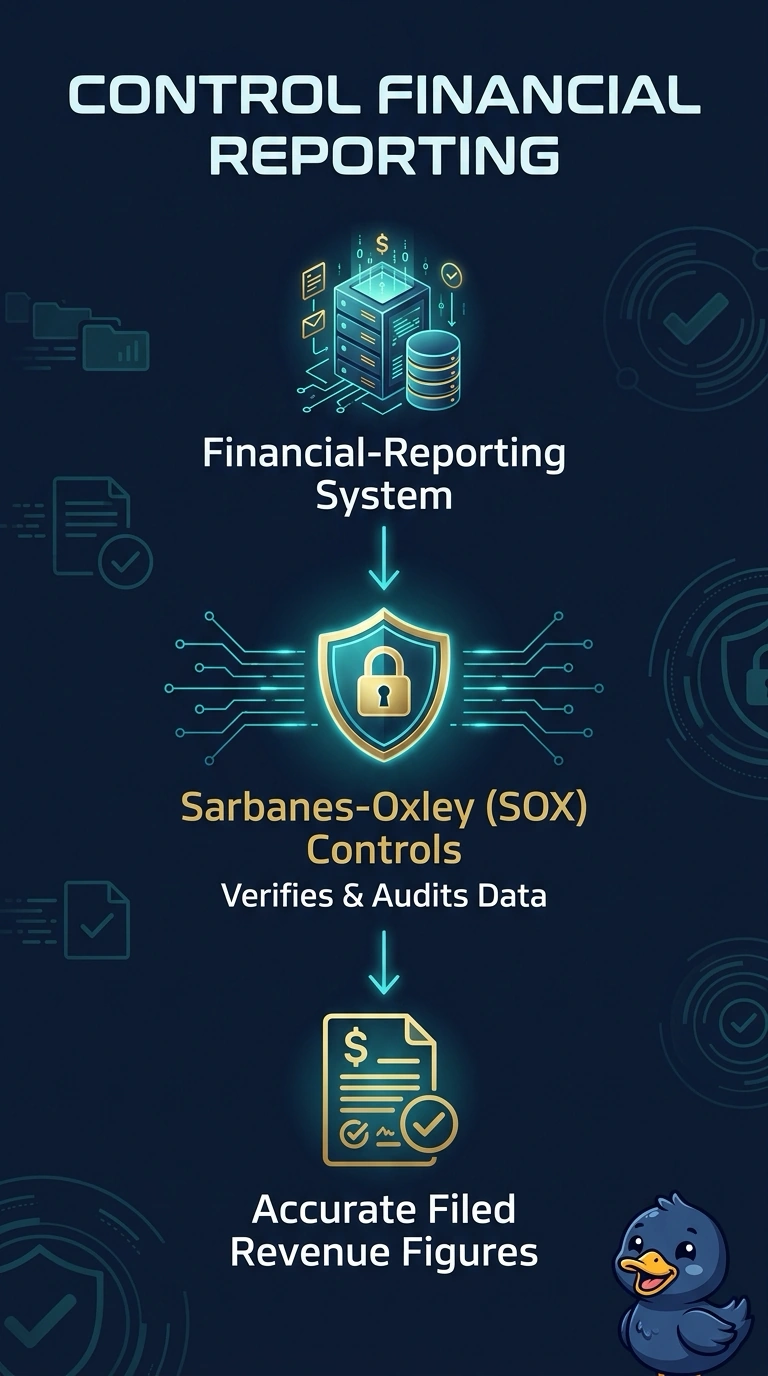
Short Explanation
The system that feeds a public filing needs the controls written for that filing. You match this revenue application to public-company financial-reporting controls. Grid-cyber rules, student-record rules, or cardholder rules govern systems this application is not.
Full Explanation
The application produces figures the mill files as a public company, so the matching requirement is internal control over financial reporting. Grid-cyber rules, student-record rules, and cardholder rules govern other kinds of systems. A mill might also take card payments somewhere else; that would be a different scope, not this revenue application. Sarbanes-Oxley controls over the financial-reporting system that produces those filed revenue figures is the design that meets this requirement. NERC CIP protections for bulk electric system cyber assets this mill does not operate is the wrong fit because bulk-electric rules apply to the power grid, and a paper mill's revenue application is not a grid cyber asset. FERPA protections for student education records this mill does not create or store is the wrong fit because student-record rules apply to education records, which a revenue filing system does not hold. PCI DSS controls for a cardholder environment this revenue application does not store is the wrong fit because cardholder rules apply where payment cards are stored or processed, and this filing system is not that environment. Exam caveat: This match is the filing application only, so a different system that later stores payment cards is classified on its own and does not rewrite this requirement. Operational check: Identify the application named in the filing control matrix and confirm change access to it is listed there, separate from any card-payment system the mill may also run.