
A privately held auto lender stores loan applications, balances, and customer government identifiers, and it does not take card payments. Which rule requires security safeguards for the lender’s covered customer information?
Select an answer to reveal the explanation.
Short Explanation
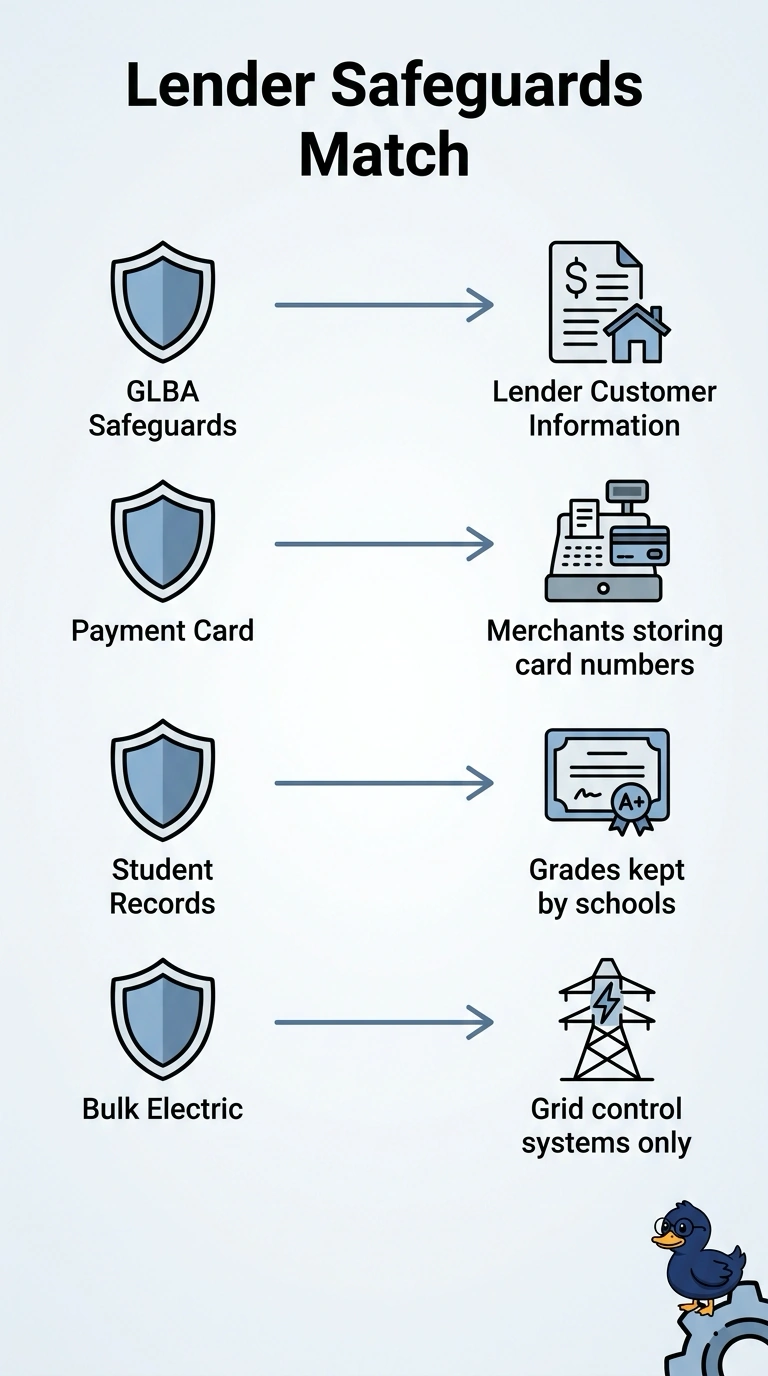
You can match the safeguard to the papers you hold. For loan applications and identifiers at this lender, you need The applicable Gramm-Leach-Bliley Act Safeguards Rule for customer information. The card, school, and grid rules cover other data, so you can set them aside.
Full Explanation
The system holds nonpublic personal information that customers gave a financial institution so it could make loans. The document that matches that data and requires security safeguards for covered customer information is The applicable Gramm-Leach-Bliley Act Safeguards Rule for customer information. That rule applies to financial institutions handling customer information and calls for a safeguards program, so it fits a privately held auto lender holding loan files. The payment-card standard that applies to merchants storing primary account numbers in that other design is the wrong fit because payment-card rules cover cardholder data at a merchant, and this lender does not take card payments. The student-record rule that applies to grades and enrollment kept by a school is the wrong fit because student-record rules cover education files kept by a school, and a loan file is not one of those records. The bulk-electric standard that applies to control systems on the power grid is the wrong fit because bulk-electric rules cover grid operations, and a consumer loan system is not a control center. This question is only about the loan files. Operational check: List the systems that store the loan applications and customer identifiers and confirm those systems are the ones matched to the safeguards document.