
A federal contractor already holds an authorization to operate a grants portal. Auditors ask which ongoing activity checks that the selected controls still work. Which framework defines that activity?
Select an answer to reveal the explanation.
Short Explanation
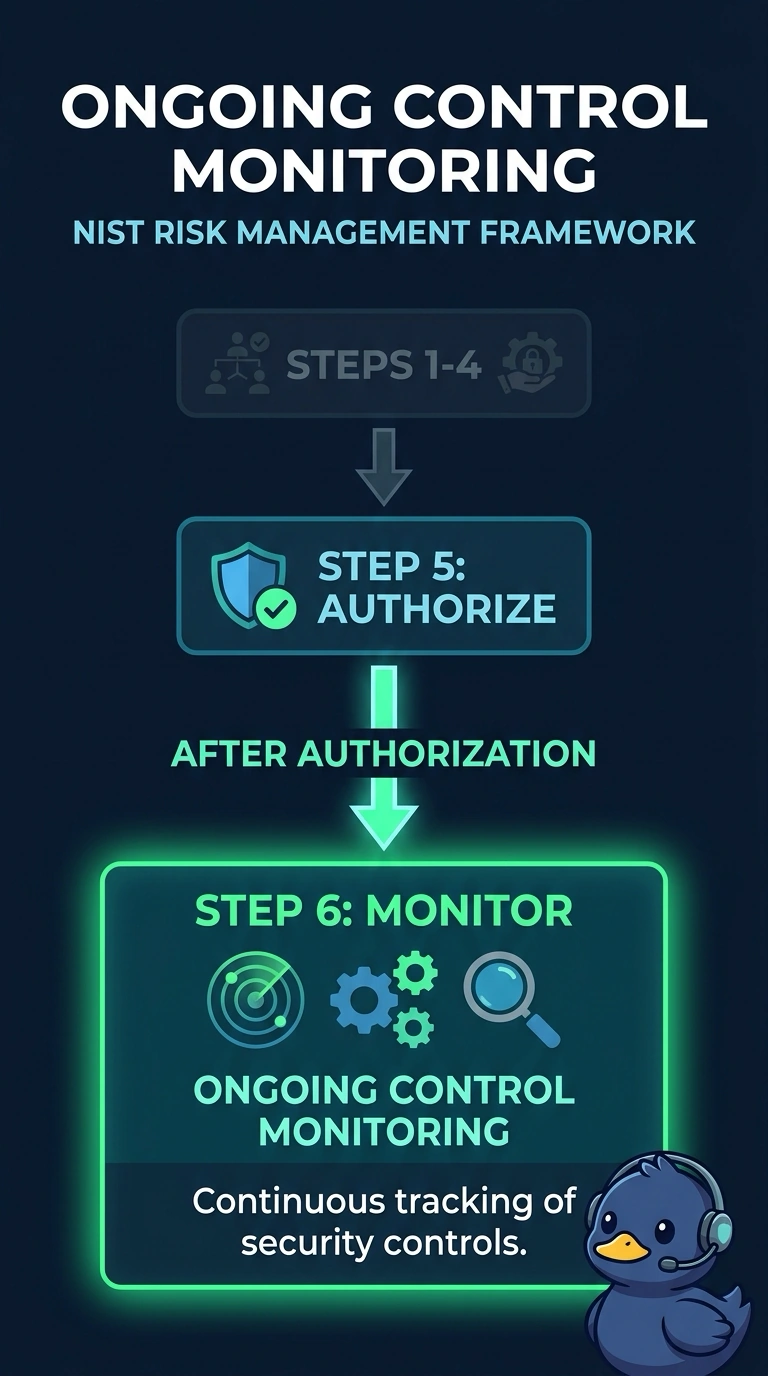
After the permit is signed, someone still has to walk the floor and see that the alarms work. You use the risk-management framework's monitor step for that ongoing check. An attack-pattern catalog, a business-flow placement guide, or a vendor hardening checklist is a different job.
Full Explanation
After a system is authorized, the risk-management framework's monitor step is the ongoing check that selected controls remain in place and still produce the expected evidence. An attack-pattern catalog helps you describe how attacks work, and a business-flow model helps you place capabilities. Neither one is the activity that watches controls after authorization, and a vendor checklist is not that framework step either. The NIST risk-management framework step that monitors controls after authorization is the design that meets this requirement. The CAPEC catalog of attack patterns used to describe how attacks are carried out is the wrong fit because an attack-pattern catalog describes adversary techniques and is not the ongoing monitor step. The Cisco SAFE placement of security capabilities along a business flow is the wrong fit because a business-flow placement guide decides where capabilities sit, not whether controls still work. A vendor hardening checklist that sits outside the authorization monitor step is the wrong fit because a vendor checklist may be useful and is not the framework monitor activity the auditors named. Exam caveat: Monitoring without a place to record failed controls turns the step into a tour, so the evidence has to land in the authorization package the contractor already maintains. Operational check: Pick one grants-portal control, compare this month's evidence with the authorized setting, and confirm the gap is recorded as a monitor finding rather than an attack-pattern entry.