
A power-tool maker's analysts see login failures, a new inbox rule, and a payment request, all for one accountant, as three separate alerts. Which SOC capability should tie them together?
Select an answer to reveal the explanation.
Short Explanation
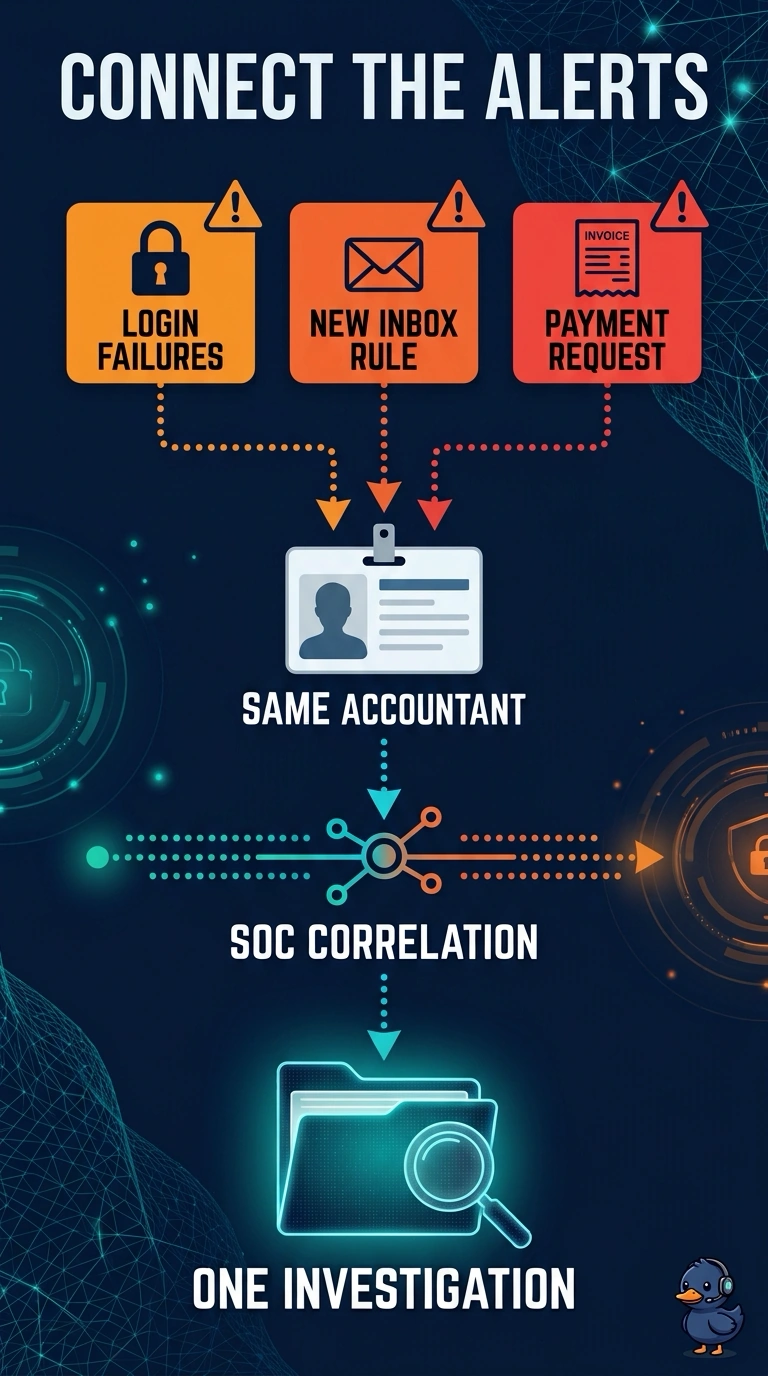
Three muddy footprints in one hall are one visitor you should follow, not three separate ghosts. You correlate the failures, the new inbox rule, and the payment request into one investigation. A fresh dashboard tile, a second copy of a single alert, or isolating every laptop with one failed login leaves the pattern broken apart.
Full Explanation
The three alerts are one accountant's story split across systems. Join the alerts for investigation using the verified account, timing, and related indicators. A dashboard tile only displays them, a duplicate of one alert adds no new fact, and an isolation playbook aimed at every failed login skips the relationship and widens the action. Correlation that links the three alerts to the same accountant and opens one investigation is the design that meets this requirement. A new dashboard tile that shows the same three alerts as separate live counts is the wrong fit because a dashboard tile displays counts and does not relate the three signals or start one investigation. A second copy of the login-failure alert with no context from the inbox rule or the payment is the wrong fit because copying one alert adds none of the inbox-rule or payment context, so the pattern stays split. An isolation playbook that disconnects every laptop that recorded a single failed login is the wrong fit because isolating every failed login acts before the signals are related and hits people outside this case. Exam caveat: Confirm whether they form one incident before containment. Operational check: Feed the three lab alerts for one test account into the SOC pipeline and confirm they become one correlated investigation rather than three unrelated tickets.